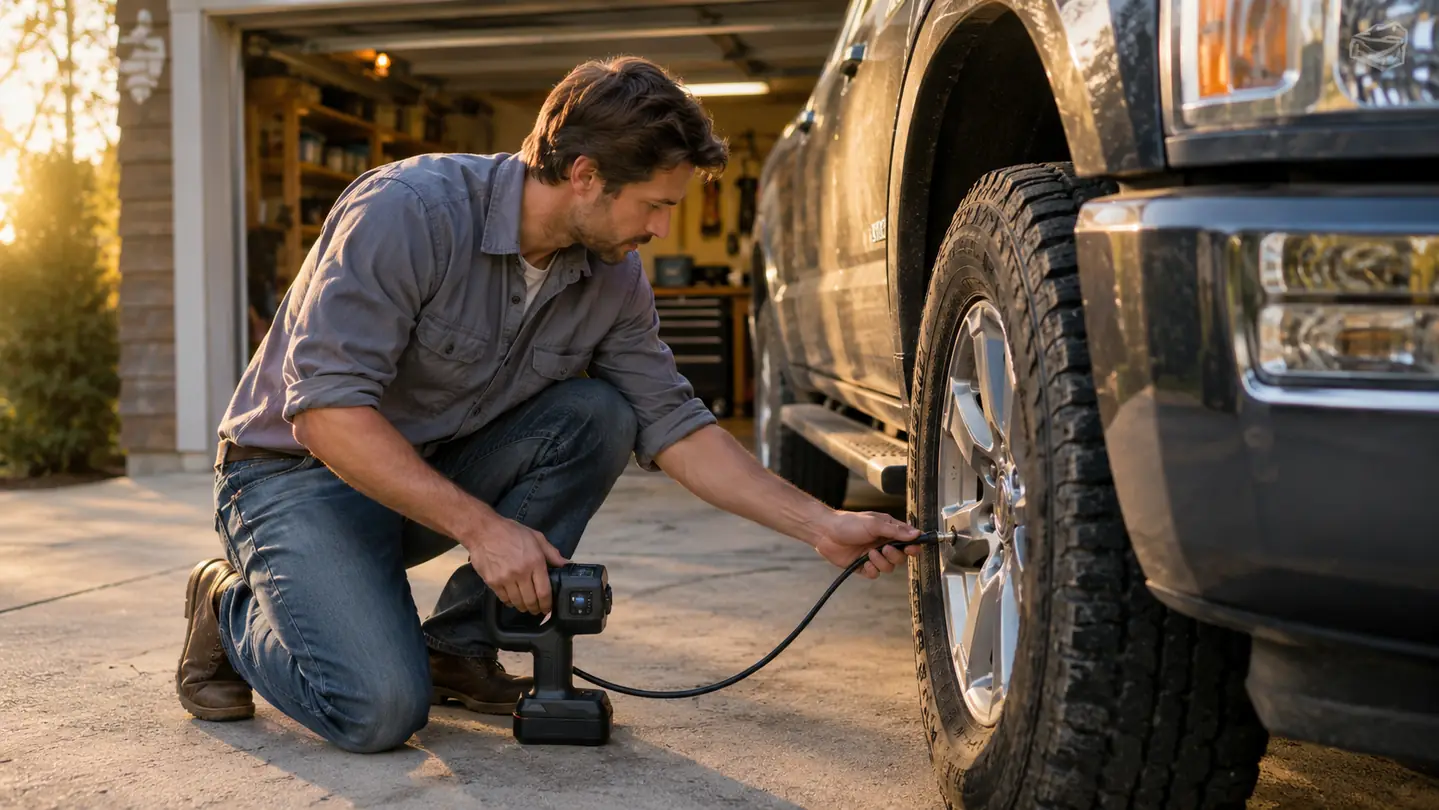
A low tire is one of those problems that never shows up at a convenient time. It is usually a Sunday evening, or a workday morning when you are already running late, and the front passenger side of the truck is sitting noticeably lower than the rest. You know the drill. You either drag out the old 12-volt compressor that takes forever and needs the engine running, or you drive to the gas station and hope the air hose is working and nobody is parked in front of it. I have done both for the better part of 30 years, and neither one is a good time. That is why I finally picked up the AVID POWER Cordless Tire Inflator, and after about six months of using it on my 2012 F-150 and on neighbors' cars, I can tell you exactly how to fix a low tire at home with it.
The short version is this: check the pressure, screw on the hose, set the target number, press the button, and walk away until it beeps. The whole job takes about three minutes per tire, and you never have to find an outlet or listen to the truck idle while you wait. Below is the step by step method I use, along with the things I wish somebody had told me the first time I used a cordless inflator.
Top Off a Low Tire in About Three Minutes, Right in Your Driveway
The AVID POWER Cordless Tire Inflator runs on a 20V battery, so there is no extension cord, no cigarette lighter plug, and no trip to the gas station. It is the tool I keep in the truck for exactly this job.
Amazon Check Today's Price on Amazon →Step 1: Check the Pressure Before You Add Any Air
I know it is tempting to just screw the hose on and start filling. Do not. You need to know what you are starting from, because that tells you whether the tire is just low or whether you have a leak that needs a different fix. I use a manual gauge first, even though the AVID POWER inflator has its own digital display. The reason is simple: the built in gauge is accurate enough for topping off, but I like a second opinion when I am deciding whether to trust a tire for a trip. Last October, my neighbor's sedan read 24 PSI on the inflator's display and 23 on my manual gauge, close enough to call it a match, but I have also seen a cheap gauge read 5 pounds high, so I do not skip the check.
For my truck, the door sticker calls for 35 PSI front and rear when the tires are cold. Cold means the truck has been sitting for at least a couple of hours, not driven straight to the gas station. If you check a tire after a long drive, the pressure reads higher because the air is hot, and you will end up underfilling it. So the right time to do this is in the morning, or after the truck has sat in the garage for a while. I usually do it on Saturday morning before I pull the truck out, when the concrete is still cool and the tires have been sitting overnight.
If the tire is at 28 PSI and the door sticker says 35, you are about 7 pounds low. That is a normal top off. If it is at 15 PSI or lower, or if it is completely flat, stop and look at the tire. A tire that loses that much air that fast has a puncture or a bad valve stem, and filling it is only a temporary fix. I will cover that more at the end.
Step 2: Screw the Inflator Hose Onto the Valve Stem
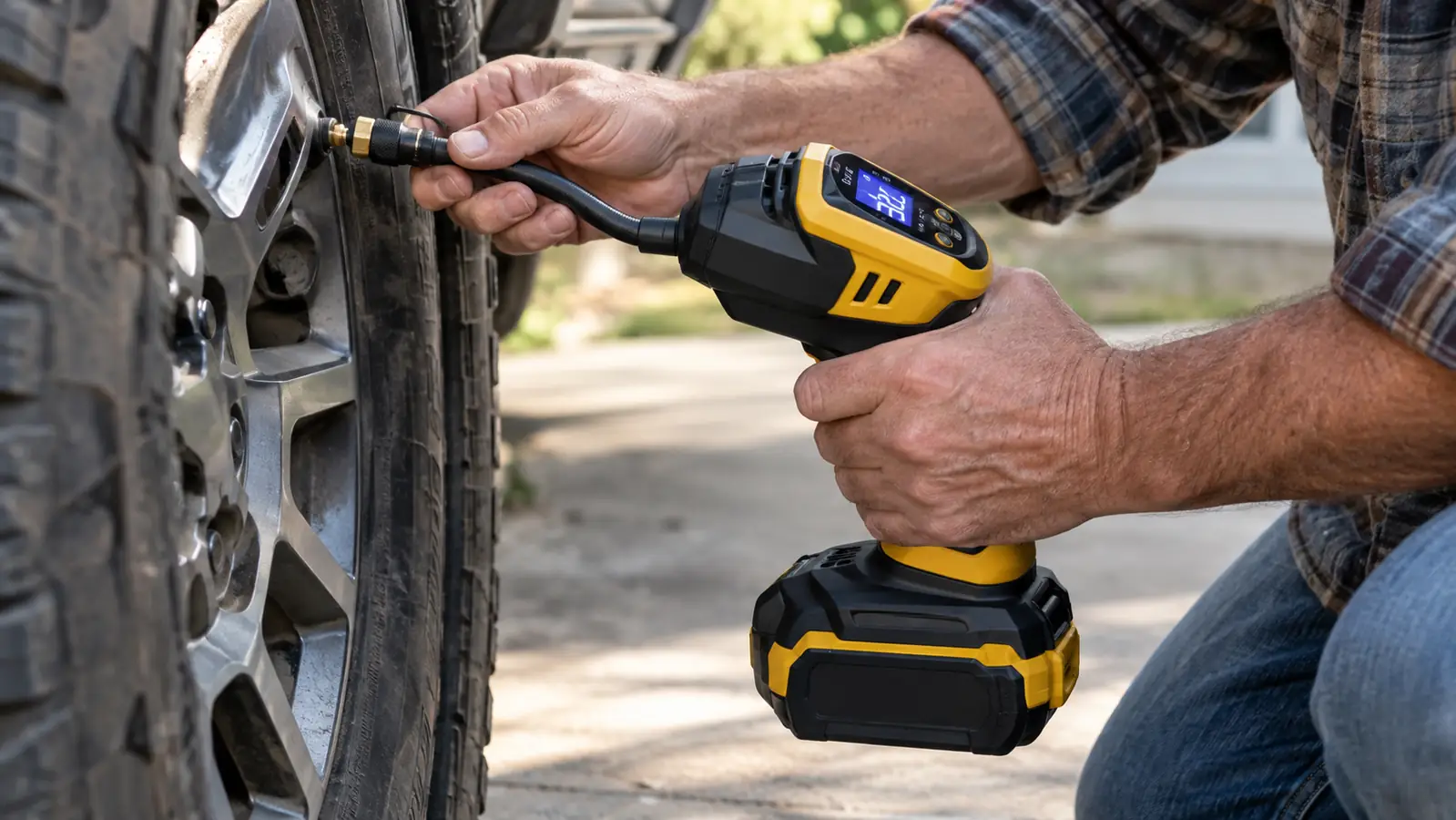
The AVID POWER inflator comes with a hose that has a brass chuck on the end. You press it over the valve stem and it threads on with a quarter turn, or you can push it on and flip the little lever to lock it. I prefer threading it on because it gives a better seal and I do not have to hold it in place with one hand while I work the controls with the other. The first time I used it, I pushed the chuck on without threading it and heard air hissing out around the seal, so now I always give it the quarter turn.
Before you attach it, pop the little dust cap off the valve stem and set it somewhere you will not lose it. I put mine in my pocket. It sounds like a small thing, but I have spent more time than I care to admit looking for a dust cap in the gravel. Also, check that the valve stem is not bent or cracked while you are down there. If it is, the inflator will not seal properly and you will hear air hissing out around the chuck. A cracked stem is a five dollar part at the parts store, but it will make every fill a fight until you replace it.
One thing I learned the hard way: make sure the hose is not kinked before you lock the chuck on. The hose on this unit is a reasonable length, but if you stretch it across the driveway at an angle, it can fold and the inflator will run forever without moving the needle. Straighten the hose out, then start. I had a kinked hose one cold January morning and stood there for five minutes wondering why the pressure was not climbing, so now I check the whole run of hose before I press the button.
Step 3: Set the Target Pressure on the Digital Display
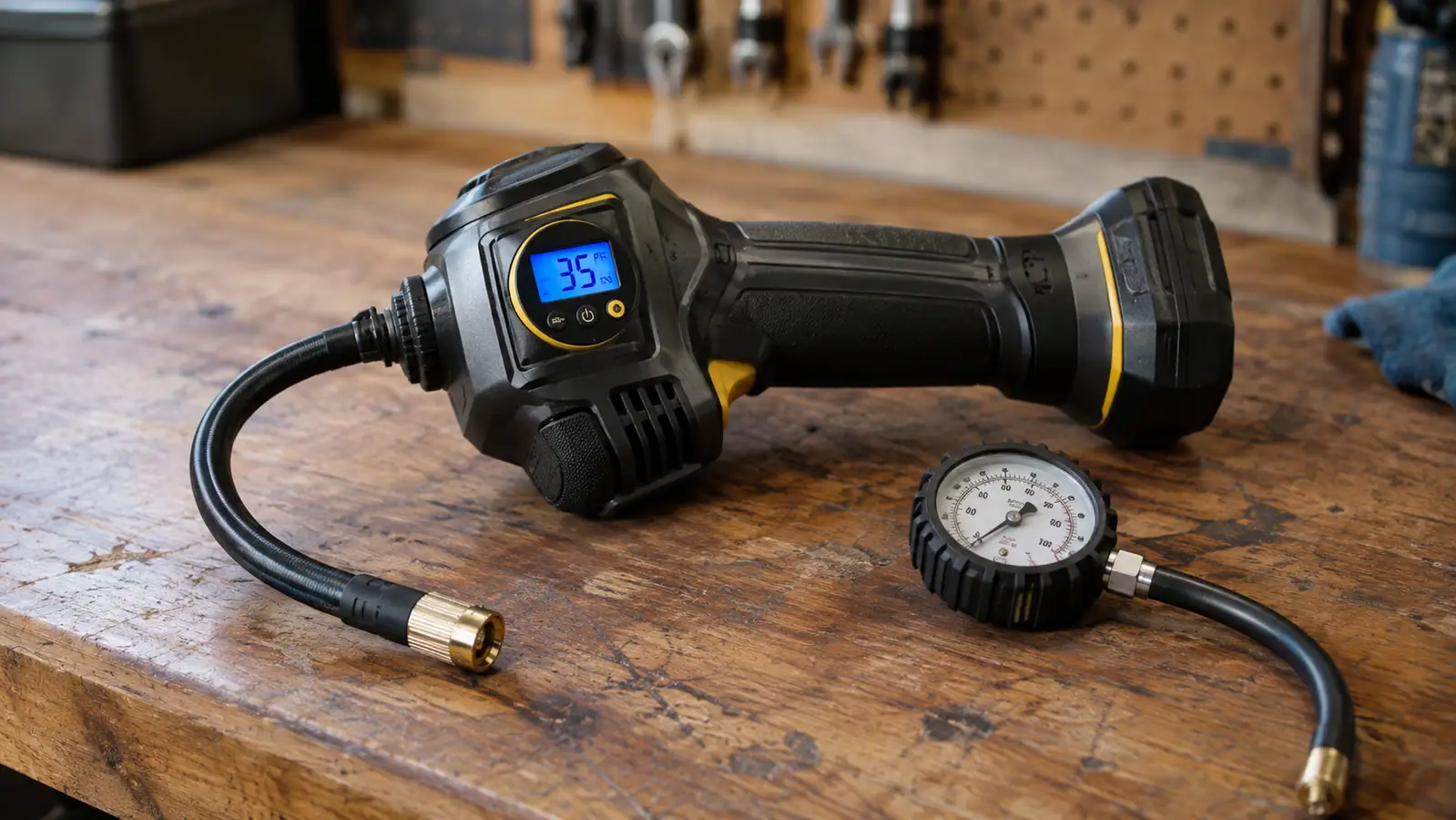
This is the feature that makes the AVID POWER inflator worth keeping in the truck. The digital display shows the current pressure as soon as you attach the hose, and you set the target pressure with the plus and minus buttons. I set mine to 35 PSI, press the start button, and the unit runs until it hits 35 and shuts off on its own. No standing there with a finger on the trigger, no guessing, no overfilling. On a cold morning in February, I set it to 35, went inside to refill my coffee, and came back to a beep and a tire that was exactly where I wanted it.
The auto shutoff is the whole point. With an old manual compressor, you have to keep checking the gauge, and the moment you look away it goes from 35 to 40. Then you have to bleed air back out, which is exactly the kind of fiddly nonsense that makes people put off fixing a low tire in the first place. With this unit, you set it and let it work. I have overfilled tires more times than I can count with the old 12-volt unit, and I have not done it once with this one.
A note on the display: it reads in PSI by default, which is what we use in the States. If you see a different unit on the screen, check the manual for how to switch it back. It is a small thing, but it will save you a confused minute the first time you use it. The buttons are simple enough that I set the target without reading the manual, but the unit of measure is the one setting worth checking before you trust the number.
Step 4: Let It Run, Then Double Check With Your Own Gauge
Press the start button and let the inflator do its job. On my truck, going from 28 to 35 PSI takes somewhere around two and a half minutes per tire. The unit is not silent, but it is not obnoxious either. It is about the same noise level as a shop vac, and since it runs on the 20V battery, I can close the garage door and not worry about fumes or an extension cord running across the driveway. I timed it once with my phone: 2 minutes and 38 seconds from 28 to 35 on a cool morning, and the battery indicator barely moved.
When it beeps and shuts off, unscrew the hose and check the pressure with your manual gauge. I do this every time, because it is the only way to know the built in display and the actual tire agree. In my experience they are close, usually within a pound, but close is not the same as exact. If the manual gauge reads 34 and you wanted 35, screw the hose back on, bump the target up by one, and run it for another twenty seconds. It is a two minute fix that keeps you from driving on an underinflated tire.
While the inflator is running, it is a good time to check the other three tires. They are probably fine, but tires lose air slowly over the winter, and it costs you nothing to top them all off while you have the tool out. I do all four at once, and I check the spare too, because a spare that is flat is just a heavy decoration. Last spring I found the spare at 18 PSI, which would not have gotten anybody anywhere, so now the spare gets checked on the first Saturday of every month along with the battery.
Step 5: Put the Inflator Away With the Battery Charged
The last step is the one most people skip, and it is the one that determines whether the tool works the next time you need it. The AVID POWER inflator takes the same 20V battery as the rest of the AVID POWER line, so I keep a spare battery charged and swap it in when the one in the inflator gets low. When I am done, I put the inflator back in its bag with the hose and the charging cable, and I put the spare battery on the charger.
A cordless tool with a dead battery is just a paperweight, and a tire inflator is only useful if it is ready when the tire is not. I learned that the first winter I owned it. I topped off a tire in November, put the inflator in the garage, and did not touch it again until March. When I needed it, the battery was too low to finish the job. Now I make a habit of checking the battery the first of every month, and I charge it after every use, even if the light says it is still half full. That one dead battery cost me a trip to the gas station on a rainy Tuesday, and I have not repeated it.
One more thing: keep the inflator in the truck, not the garage. The whole reason to own a cordless unit is that it is there when you need it, and a low tire does not care whether you are in your own driveway or at the grocery store. Mine rides behind the seat in its bag, and it has bailed me out twice on the side of the road. The first time was a slow leak on the way to work, and the second was a neighbor's sedan at the church parking lot, and both times I was done in under five minutes.
What Else Helps
A cordless inflator handles the air, but a few other things make the job easier. A good manual tire pressure gauge costs a few dollars and gives you a second reading. A small flashlight with a magnetic base is worth its weight when you are kneeling next to a dark tire at 6 AM. And a valve stem tool, the little plastic thing with a notch in it, is handy for snugging up a loose core. None of these are expensive, and they all fit in the same bag as the inflator. I keep all three in the center console of the truck, so I never have to go back to the garage for them.
I also keep a plug kit and a small compressor in the garage for actual punctures. The AVID POWER inflator is the right tool for a low tire, but it is not a repair tool. If you have a nail in the tire, the inflator will get you to a shop, and that is a perfectly good job for it. Just do not expect it to fix a hole. I have plugged a couple of tires in my driveway over the years, and the inflator is what gets the tire back up to pressure so I can find the leak in the first place.
The auto shutoff is the whole point. Set it to 35, press the button, and walk away until it beeps. That is the difference between a tool you use and a tool you avoid.
Keep One Behind the Seat and Never Hunt for an Air Hose Again
The AVID POWER Cordless Tire Inflator is the tool I reach for first now, whether it is my truck or a neighbor's sedan. It sets the pressure, shuts off on its own, and runs on a battery I already keep charged.
Amazon Check Today's Price on Amazon →