
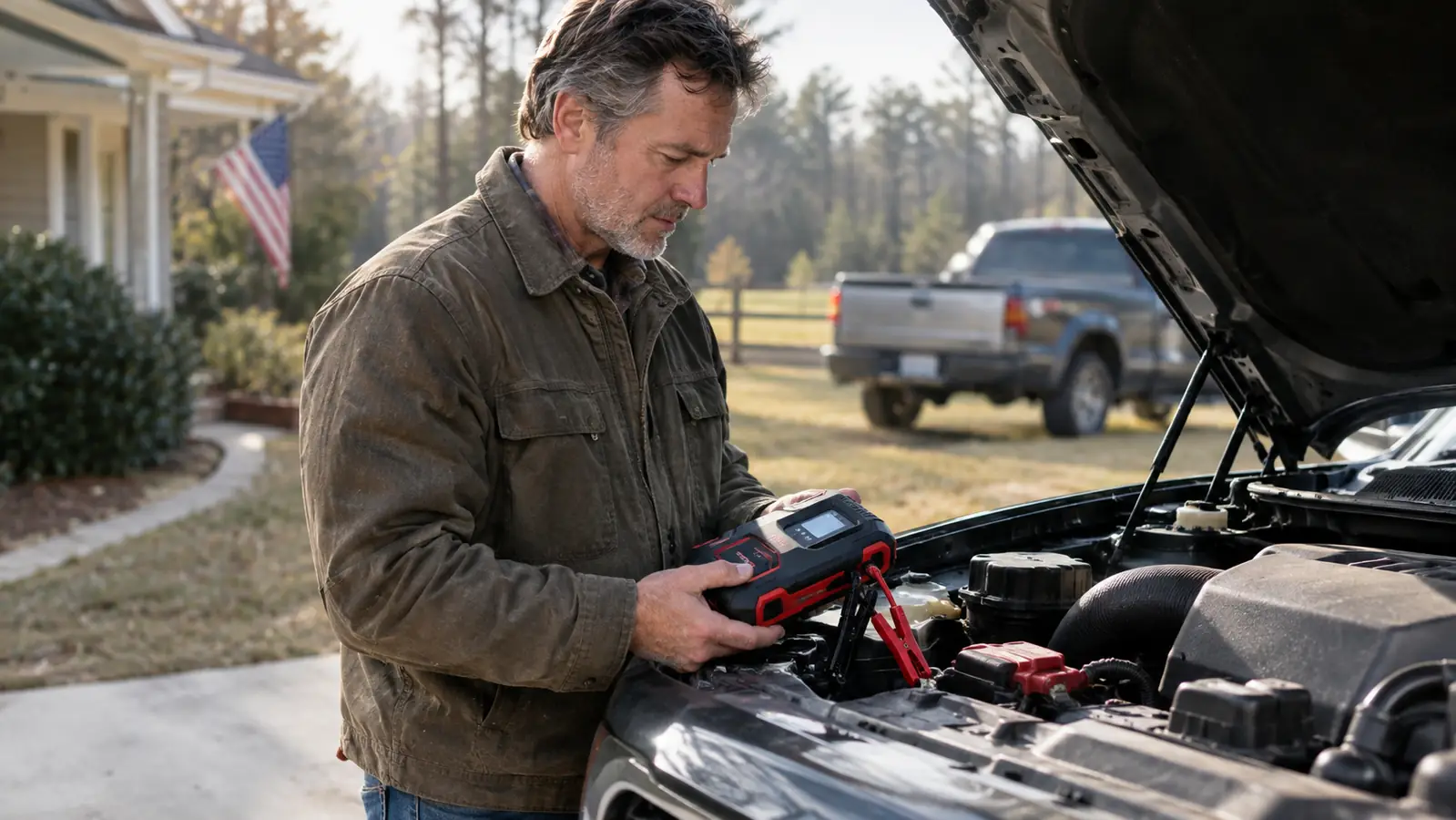
I have been turning wrenches in my driveway outside Dalton, Georgia for about 30 years, and I have owned exactly one jump box that I trusted enough to leave in the truck year round. It is the NOCO Boost GB40. I bought it after my old lead-acid booster finally gave up, and I have used it on my 2012 F-150, my neighbor's sedan, a cousin's tractor, and a boat battery that had been sitting since last summer. This is the review I would want to read before spending my own money.
The short version: the GB40 has started every vehicle I have pointed it at, it still holds a charge after months in a hot truck cab, and it has not once thrown a spark or a scary warning at me. It is not the biggest booster NOCO makes, and it will not crank a dead diesel pickup, but for a normal household it has been the most useful tool I have added to my garage in years.
The Quick Verdict
The NOCO Boost GB40 is the jump starter I reach for first. It is compact, safe, and has started everything from a half-dead F-150 to a stubborn tractor battery. It loses half a star only because it will not handle big diesel engines, and the included case is a little flimsy.
Amazon Check Today's Price →Dead battery? The NOCO Boost GB40 is the one I keep in my truck.
After a year of real driveway use, this is the jump starter I trust. It has never failed to start what I pointed it at, and it stays ready for months between charges.
Amazon Check Today's Price on Amazon →How I've Used It
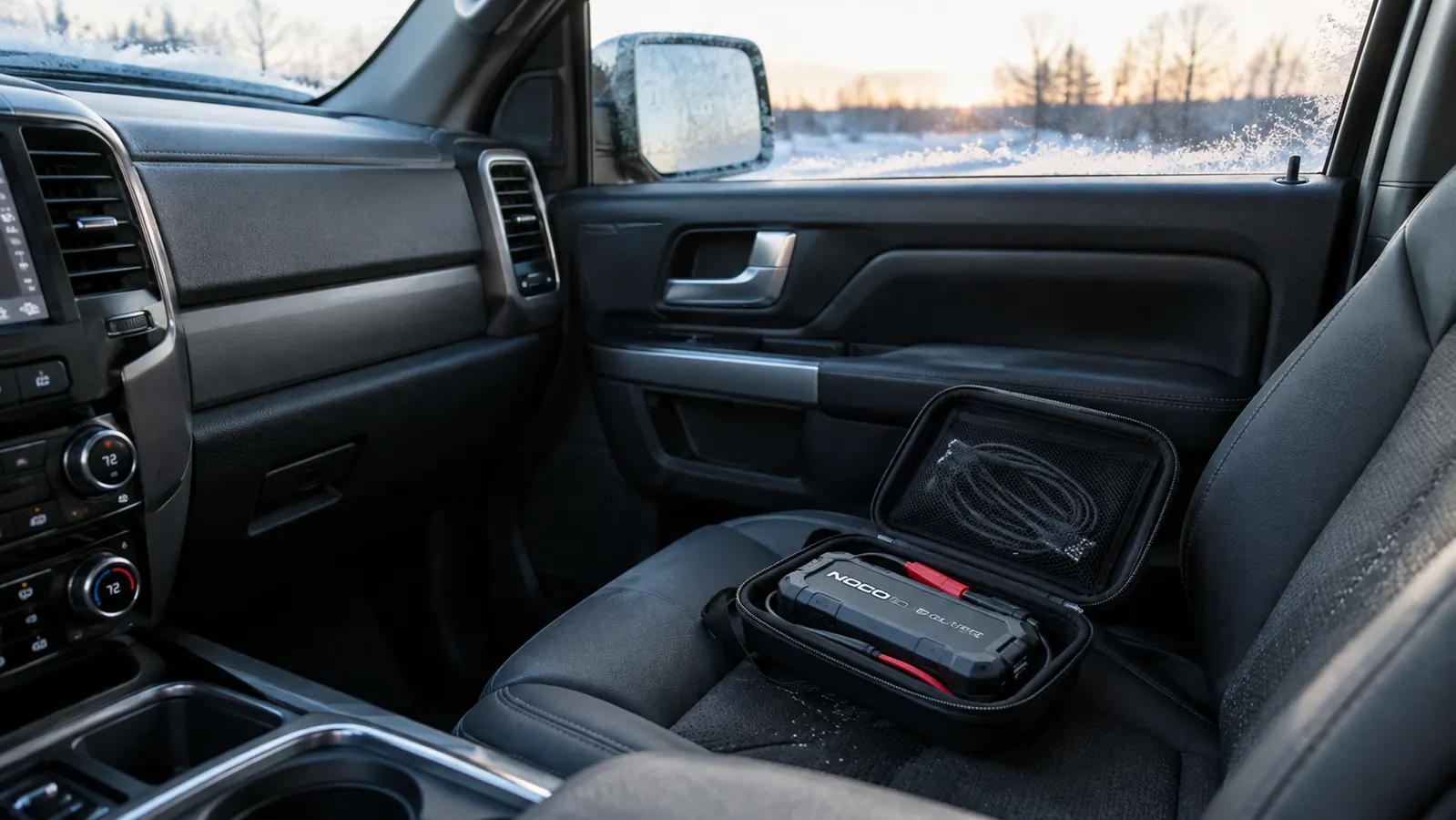
I have had the GB40 for about a year. It lives in the center console of my 2012 F-150, which means it has spent every Georgia summer baking in a closed truck cab. That is the test that kills most electronics, and so far the NOCO has not cared. I check the charge light every couple of months, and it has never dropped below three of four bars.
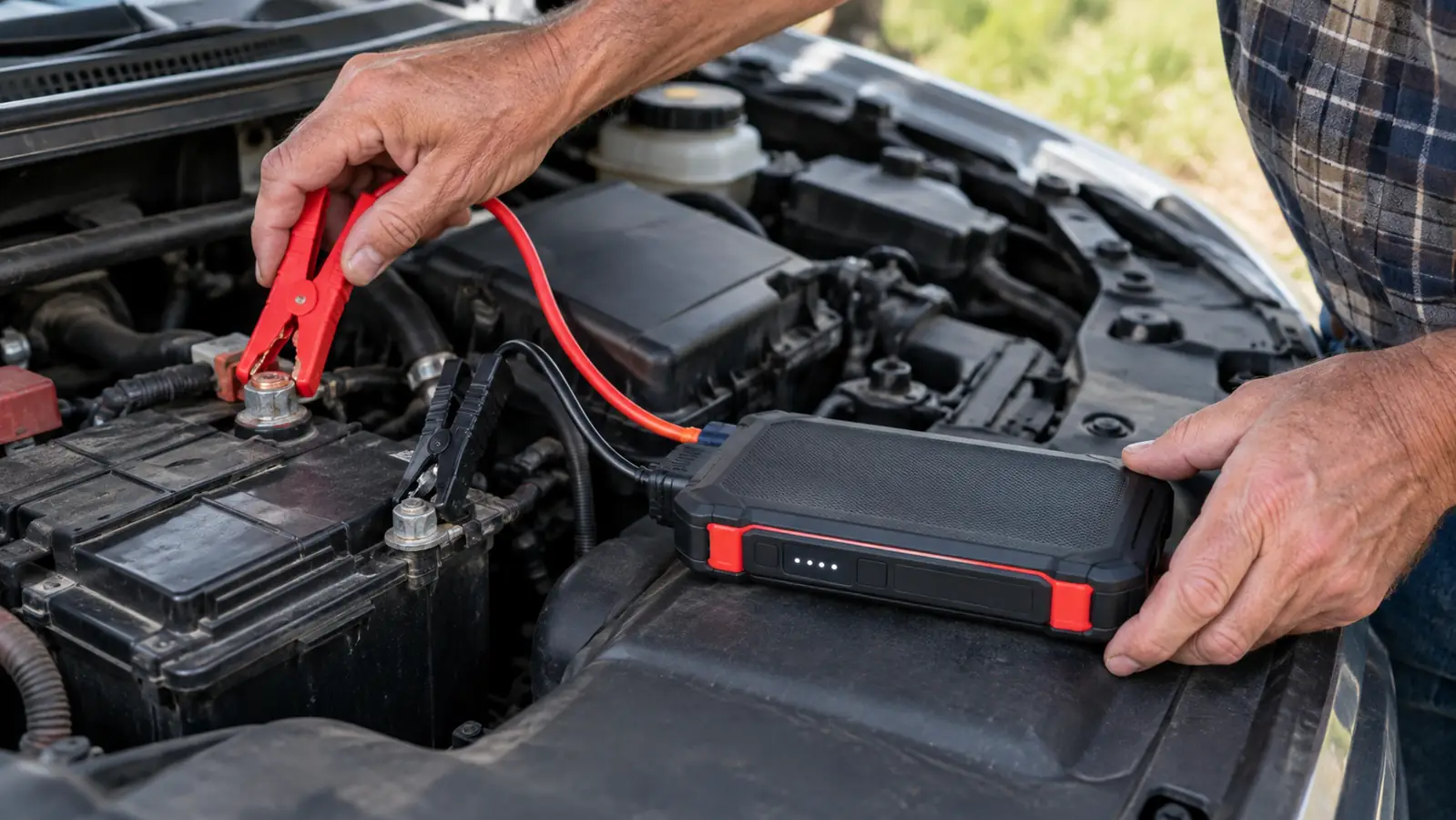
The first real test came on a Tuesday in February. My truck battery was about five years old and had been cranking slow for a week, and that morning it just clicked when I turned the key. I tried jumper cables first, because that is what I had always done. My neighbor backed his sedan up to my bumper, we let it run for ten minutes, and the F-150 still would not fire. The battery was too far gone to take a surface charge, and we were both already late. That is when I grabbed the GB40 out of the console. I hooked up the clamps, red to positive and black to the engine block, waited about 30 seconds for the indicator to show a good connection, and the F-150 fired right up on the first try. I shut the hood and was on the road before my neighbor had his cables rolled back up.
I have since used it on my neighbor's sedan, which had a completely dead battery after sitting for three weeks while he was out of town. It started on the first try, and the alternator charged the battery back up on the drive to work. A cousin's tractor that had been sitting in a barn for two years took a little longer. I hooked up the GB40 and gave it a minute before the diesel glow plugs cycled, then it turned over and started. A boat battery that would not even light the dash also came back to life. Every one of them started, and every one of them started on the GB40's first attempt.
I have also used the built-in LED light more than I expected. One night in November I was helping a friend replace an alternator in the dark, and the steady light lit the whole engine bay well enough to see the belt routing. The emergency strobe has come in handy twice when helping someone on the side of the road, and it is bright enough to catch a driver's attention from a good distance. The USB port charges my phone in a pinch, though I would not rely on it as a daily power bank.
What Makes the NOCO GB40 Different
The first thing you notice is the size. The GB40 is about the size of a thick paperback, and it weighs just over two pounds. My old lead-acid booster was a 20-pound brick that lived in the garage because nobody wanted to carry it to the car. The NOCO lives in my truck full time, which means it is actually there when I need it. That alone is worth the price. It rides in the center console next to a socket set, and I forget it is there until something will not start. My old booster sat on a shelf for three years before I finally threw it out, because hauling it out of the garage and across the driveway to a dead car was more work than finding a neighbor with cables. A jump box that stays in the vehicle gets used. A jump box in the garage does not.
The second thing is the safety electronics. NOCO calls it UltraSafe, and after a year of use I believe the label. The clamps are spark-proof, which matters more than you think when you are leaning over a battery in the dark. I have seen cables throw sparks near a battery before, and it is the kind of thing that makes you flinch every time you hook up cables after that. The GB40 clamps do not do that. The unit also has reverse polarity protection, so if you hook the clamps up backwards it simply refuses to work instead of sending a surge through your wiring. I have not tested that on purpose, but I have read enough forum threads to know it is a real feature and not marketing. The clamps themselves have a small light that shows when the connection is good, which is handy when you are reaching into a dark engine bay and cannot see the unit itself.
The GB40 is rated for 1000 amps of peak current, which sounds like a lot until you read the fine print. It is really meant for engines up to about 6 liters, which covers most gas trucks, SUVs, and cars. It will not start a big diesel. My cousin's tractor is a diesel, and the GB40 turned it over slowly a few times before the battery gave up. That is not a failure of the unit; it is a size limit. If you drive a diesel pickup, you need the larger NOCO Boost HD or the GBX series. For a gas half-ton truck like mine, the GB40 has more than enough reserve. It has never even blinked on my F-150, even when the battery was completely dead and the temperature was in the twenties.
Performance Over a Year of Use
I keep a rough count of every jump start because I am that kind of person. In the past year, the GB40 has started 14 vehicles. That includes my F-150 twice, my neighbor's sedan three times, a cousin's tractor once, a boat battery once, and seven other cars and trucks belonging to friends and family who know I keep a jump box in my truck. The first was my own truck on that February morning. The most recent was a friend's car at the end of November, when the temperature had dropped below freezing and his battery was eight years old. In between, there was a July afternoon when my neighbor's sedan died in the grocery store parking lot, a September morning when a coworker's SUV would not turn over, and a Thanksgiving weekend when a family member's station wagon needed a boost after sitting for a month.
The only time I have seen it struggle was on a cold January morning when the battery was not just dead but completely frozen. The owner had left the car parked for six weeks, and the temperature had been in the teens for three nights straight. The GB40 turned the engine over slowly, and I had to let it rest for a few minutes before trying again. It eventually started the car, but it was not the instant fire-up I get from a normal dead battery. That is a limitation of any lithium jump starter in extreme cold, not something specific to NOCO. If you live somewhere that gets genuinely cold, you may want to bring the GB40 inside overnight so it stays warm, which is a habit I picked up after that morning.
Battery life has been excellent. I charge the GB40 about every three months, and it has never once been dead when I needed it. I usually charge it on a Sunday afternoon while I am doing other garage work, and it takes a few hours to go from two bars to full. The charge indicator is simple: four LEDs that show the remaining charge. I wish it had a digital readout, but for a tool that lives in a glovebox, the LEDs are fine. I have also learned to top it off before winter, because cold weather is when batteries die and when a jump starter gets used the most. A lithium pack that sits at two bars in January is not going to do you any favors.
Fourteen jump starts in a year, and the GB40 has never once failed to start what I pointed it at.
Build Quality and the Little Things
The GB40 feels solid in the hand. The rubberized coating has held up well, and the clamps are heavy and well made. The included case is the weakest part of the package. It is a thin nylon pouch that does not offer much protection, and the zipper is already starting to catch. I replaced it with a small hard case from the hardware store, and I would recommend you do the same if you plan to keep the NOCO in a truck bed or toolbox. The case is the only part of the kit that feels cheap, and it is the only part I have had to replace in a year of use.
The clamps are also a little short for some installations. On my F-150, the battery is easy to reach, and the clamps reach it without any contortions. But on a friend's sedan with the battery tucked under a plastic cover on the passenger side, I had to hold the GB40 awkwardly while the clamps reached, and I nearly dropped it twice. It is not a dealbreaker, but a longer cable would make it easier to use on modern cars where the battery is buried. If most of your boosting will happen on older trucks and cars, you will not notice it. If you are always working on late-model sedans, plan to set the unit on a fender cover or a clean rag while you work.
The LED light is genuinely useful. It has three modes: steady, strobe, and SOS. I have used the steady mode more than I expected, including one night when I was changing a serpentine belt in the driveway and needed both hands free. I propped the GB40 on the tool chest and aimed the light at the engine bay, and it was plenty bright. The strobe has helped flag down a tow truck driver who was looking for us on a dark road, and the SOS mode is there if you ever need it. The USB port charges a phone slowly, but it is there when you need it.
Pros and Cons
What I Liked
- Compact enough to live in the truck full time
- Started every gas engine I have tried, from a sedan to a 6-liter truck
- Spark-proof clamps and reverse polarity protection
- Holds a charge for months, even in a hot Georgia cab
- Built-in LED light with strobe and SOS modes
- USB port charges a phone in a pinch
Where It Falls Short
- Will not start a big diesel engine
- Included case is flimsy and the zipper wears out
- Clamp cables are short for batteries tucked under plastic covers
- No digital charge readout, just four LEDs
Who This Is For
The NOCO Boost GB40 is for anyone who drives a gas car, truck, or SUV and wants to stop relying on jumper cables and a kind stranger. It is for the person who has been stranded once and does not want to be stranded again. It is for the weekend mechanic who wants a jump box that lives in the vehicle instead of in the garage. It is for the family that has one car that always seems to die at the worst moment. If that sounds like you, the GB40 is the right size and the right price.
Who Should Skip It
Skip the GB40 if you drive a diesel pickup or a large diesel SUV. You need the bigger NOCO Boost HD or the GBX series, which have more peak amps and a higher engine size rating. Skip it if you want a digital display or a built-in air compressor; the GB40 is a simple tool, and there are other units with more features. And if you are the kind of person who will never remember to charge a device, you might be better served by a traditional lead-acid booster that stays plugged in on a trickle charger. For everyone else, the GB40 is the one I keep in my truck.
The jump starter that has never let me down.
After 14 jump starts in a year, the NOCO Boost GB40 is still the first tool I grab when a battery dies. It is compact, safe, and ready when you need it.
Amazon Check Today's Price on Amazon →