
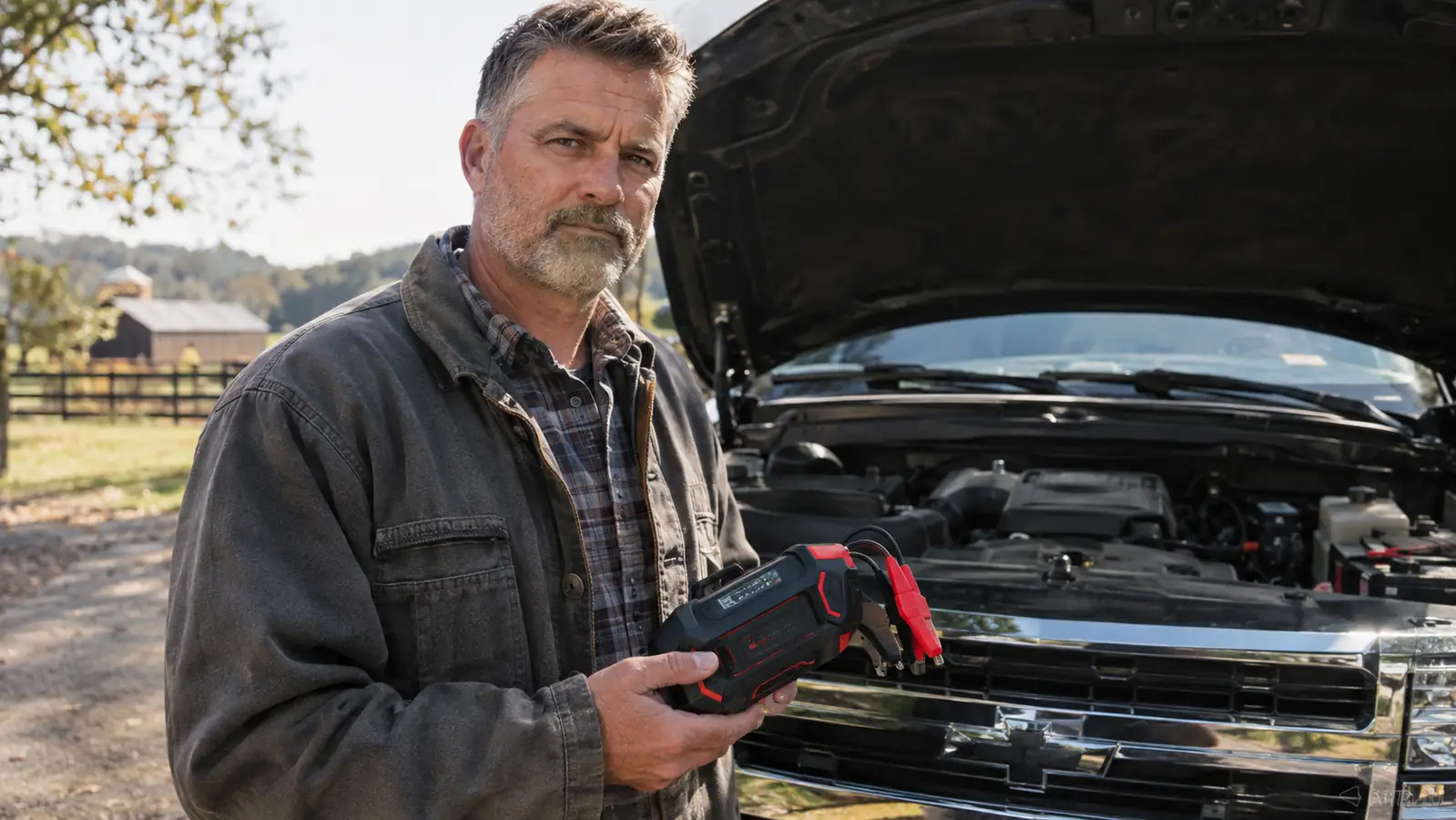
If you have ever stood in a cold driveway holding a pair of jumper cables and hoping a neighbor with a running car will pull in, you already know the problem I am talking about. I am Wade Tillman, and I have been doing my own brakes, oil changes and small repairs in my driveway outside Dalton, Georgia for about 30 years. My daily driver is a 2012 Ford F-150 with 187,000 miles on it, and it has left me stranded more times than I care to count. I bought the NOCO Boost GB40 last fall after my old cables finally gave up, and I have used it enough times since then to have a real opinion on the comparison.
The short answer is that the NOCO Boost GB40 beats jumper cables for almost everything a weekend mechanic actually does. Cables still have one job they do better, and I will get to that. But if you only own one thing to handle a dead battery, the NOCO is the one I would put in your truck.
Stop waiting on a neighbor with a running car
The NOCO Boost GB40 jump starter fits in your glove box and starts a dead battery in about a minute, with no second vehicle needed. It is the tool I reach for first in my own driveway.
Amazon Check Today's Price on Amazon →How I Tested Both
I did not test these in a lab. I tested them the way a weekend mechanic actually uses them. Over the past year I have used the NOCO Boost GB40 on my own F-150 twice, on my neighbor's sedan once, and on a friend's tractor battery that had been sitting all winter. I also kept a 12-foot set of copper jumper cables in the bed of my truck for the same period, and I used them the old-fashioned way whenever a second vehicle was available.
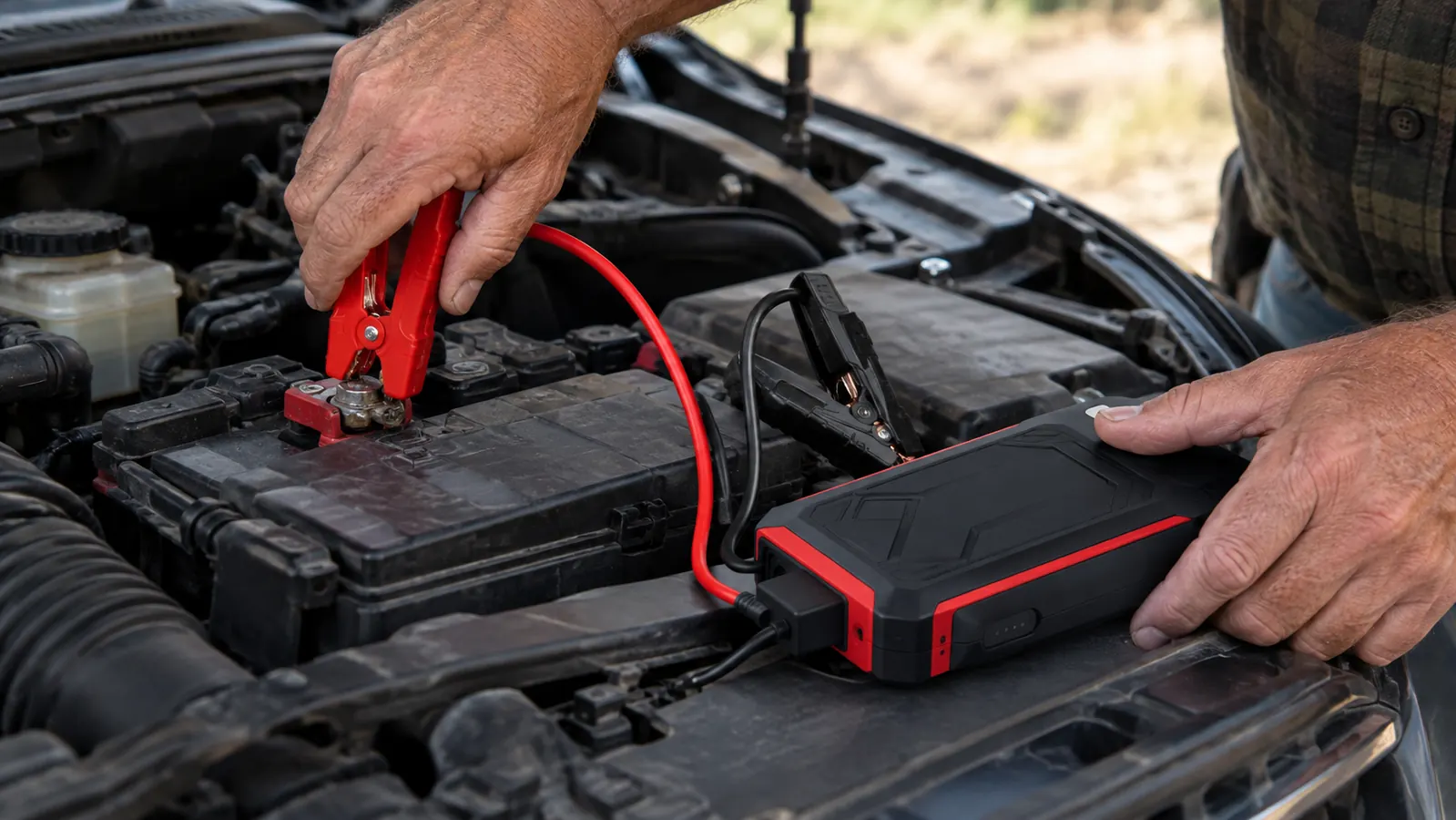
The first real test came on a Tuesday morning in late October. I went out to start the truck and got nothing but a single click from the starter solenoid. The battery was six years old and had been getting slow to crank all summer, so I was not surprised. What I wanted to know was whether the NOCO would fire a tired 5.0-liter V8 on the first try. I hooked the red clamp to the positive post, the black clamp to a bare bolt on the engine block, and waited for the green light. It took about ninety seconds of charging before the dash lights came up strong, and the truck fired on the second crank. I let it run for ten minutes, then shut it off and started it again cold to make sure the battery had taken a real charge.
The second test was the opposite situation. A friend's car died in my driveway with my truck parked right beside it, so cables were the natural choice. That jump went fine too, and it reminded me that when two vehicles are already nose to nose, cables are quick and free. The difference is that I had to back my truck out and reposition it, dig the cables out from behind the seat, and stand there while my engine charged his battery for a few minutes. The NOCO would have had him running in under a minute without moving anything.
I paid attention to the things that matter when you are kneeling on concrete in the dark: how long the setup took, whether I needed a second person, whether the clamps stayed put, and whether the thing still worked after a hot Georgia summer in a truck cab. I also checked the NOCO's battery level before every use, because a jump starter that is dead itself is just a paperweight.
The Big Difference: Independence
Jumper cables require a second vehicle. That is the whole job. You have to find someone willing to pull up close enough, pop their hood, and let you clamp onto their battery. In my experience, that is the part that fails. Not the cables, not the battery, but the availability of a second car. The NOCO Boost GB40 removes that variable completely. It is a 12-volt lithium jump starter rated at 1000 amps, and it has started my 5.0-liter V8 without breaking a sweat.
That second vehicle also has to fit. In a tight parking lot, a garage, or a car parked nose in against a wall, getting two batteries within reach of a set of cables can be the hardest part of the job. I once spent ten minutes helping a woman back her car out of a space just so my truck could reach it. The NOCO does not care where the dead car is parked. If you can open the hood, you can jump it.
The independence matters even more in a rural area like mine. My nearest neighbor is a quarter mile down the road. When my truck died at the end of the driveway last winter, I did not have to walk anywhere. I opened the hood, hooked up the NOCO, and was driving five minutes later. That alone settled the argument for me.
I have also used the NOCO to help other people, which is where cables really fall apart. Last spring my neighbor's sedan would not start in her carport. With cables, the routine would have been: she finds someone to drive over, we park nose to nose, we both pop hoods, and we hope the geometry works. Instead I walked across the yard with the NOCO in my coat pocket, had her car running in under five minutes, and was back in my garage before she finished thanking me. That is the kind of difference that is hard to put a dollar figure on.
| NOCO Boost GB40 | Jumper Cables | |
|---|---|---|
| Needs a second vehicle | No, it is self-contained | Yes, always |
| Time to start a dead battery | About 1 minute once the hood is open | 5 to 10 minutes with setup and a donor car |
| Works in the dark | Built-in LED light | Needs a flashlight or a phone |
| Can charge a phone or tablet | Yes, USB port | No |
| Cost if it fails | A tool that needs recharging every few months | A set of cables that never dies |
| Best for | Weekend mechanics who work alone | Households with two cars and a short driveway |
Where the NOCO Wins
The NOCO Boost GB40 wins on convenience in every way that matters to me. It is small enough to live in my center console, so it is always with the truck. It has a built-in LED light that I have used more than once at night, and the clamps are marked clearly so I do not have to guess which side is positive. The unit also has a USB port, which means it doubles as a phone charger on road trips. For a guy who does his own work, that is a lot of utility in one small box.
It also wins on safety. The NOCO has spark-proof clamps and reverse polarity protection, which matters when you are working in a hurry. I have seen people arc cables across a battery and ruin a day. The NOCO simply will not spark if you hook it up wrong, and it will not let you connect it backwards. That is worth a lot when you are tired and it is cold outside.
Cables leave more room for mistakes. The order you connect them matters, the last clamp should go to bare metal away from the battery, and a crossed connection can damage electronics on either car. I know the sequence by heart, but I have watched plenty of people get it wrong in a hurry. With the NOCO the protections handle the most dangerous errors for you, and the clamps stay dead until the unit confirms a good connection.
The build quality has held up through a full Georgia year, and that is the test I trust most. The NOCO has spent every day since October in my center console, which means it has baked in a closed truck cab through July and August. When I pulled it out in September to top off the charge, the case was still solid, the clamps still had their spring, and the rubber boots on the jaws had not gone brittle. I have owned cheap jump boxes that swelled up and died after one summer in the heat. This one has not even blinked.
Where Jumper Cables Win
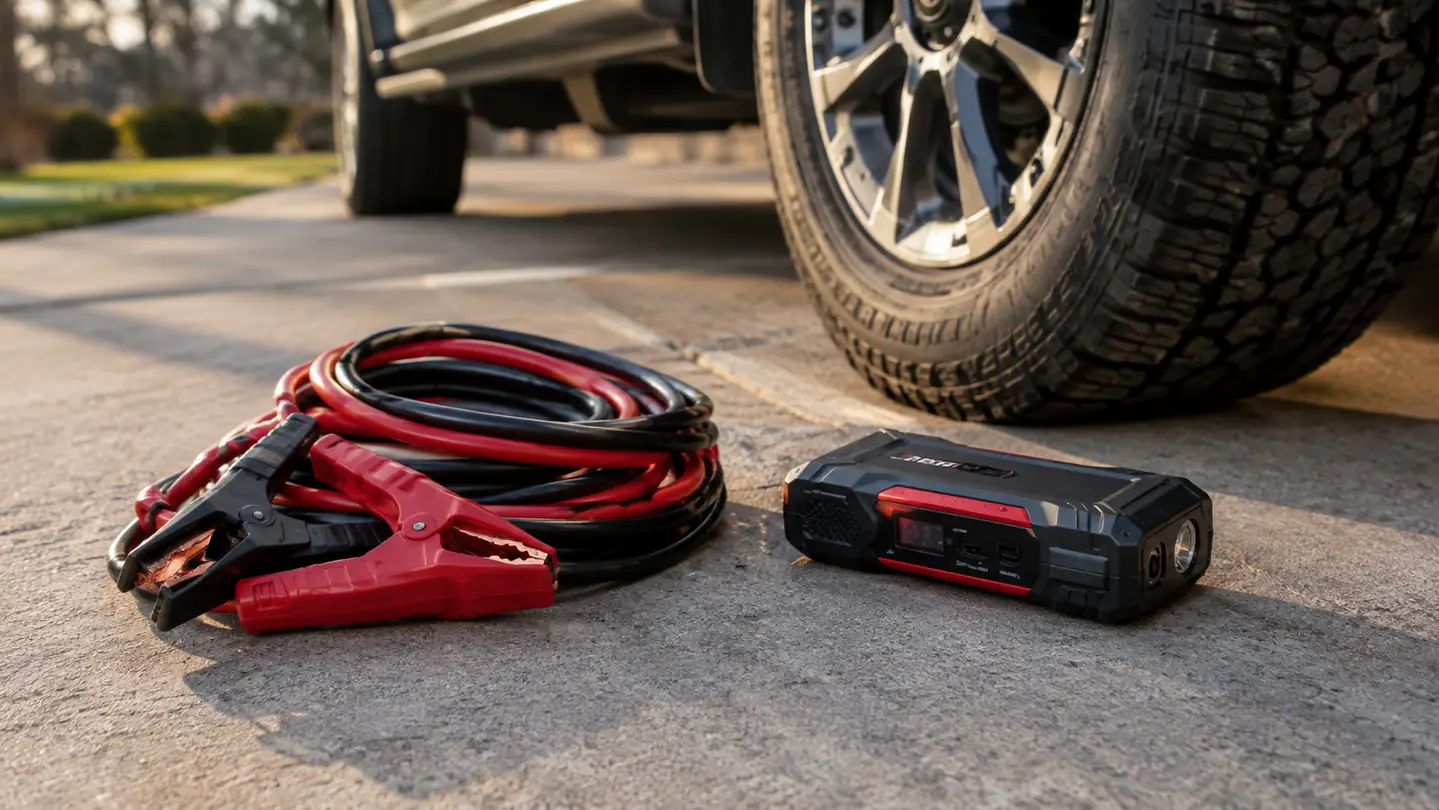
I am not going to tell you cables are useless, because they are not. A set of jumper cables never needs a charge. You can leave them in the bed of your truck for ten years and they will still work the day you need them. The NOCO Boost GB40 is a battery, and batteries lose charge over time. If you forget to recharge it every few months, you might find yourself holding a dead jump starter and a pair of cables that would have worked fine.
Cables also win on price. A good set of 12-foot cables costs a fraction of what the NOCO costs, and they have no electronics to fail. If you have two cars in the driveway and a neighbor who is always home, cables may be all you ever need. I still keep a set in my garage for the rare case where the NOCO is dead and a second vehicle is available. It is cheap insurance.
If you go with cables, buy decent ones. A heavier gauge cable, something like 4 or 6 gauge, carries current much better than the thin sets that come in cheap roadside kits, and longer cables give you more options for how the cars are parked. Thin, short cables are the reason a lot of people think jump starting is unreliable. The cable gets warm, the dead car barely cranks, and everybody stands around waiting.
There is one more thing cables do that the NOCO cannot: they let you jump a car from a running vehicle that is already there. If you are at a gas station and a stranger offers a boost, cables take thirty seconds and do not touch your jump starter's battery at all. The NOCO is the better tool when you are alone. Cables are the better tool when you are not. That is why I own both, and why I think most weekend mechanics should too.
The NOCO Boost GB40 has started my 5.0-liter V8 in about a minute, in the dark, with no second vehicle in sight. That is the whole argument.
The tool I keep in my truck every day
After a year of real use, the NOCO Boost GB40 is the jump starter I reach for first. It is small, it is reliable, and it has never let me down.
Amazon Check Today's Price on Amazon →Who Should Buy Which
Buy the NOCO Boost GB40 if you are a weekend mechanic like me, if you drive an older truck, or if you ever find yourself alone with a dead battery. Buy it if you want to help a neighbor without asking them to drive anywhere. Buy it if you work on cars at night or in a rural area where a second vehicle is not guaranteed.
My own setup is both. The NOCO lives in the glove box, and a set of heavy cables lives behind the seat as a backup. The NOCO handles nearly every situation by itself, and the cables cover the rare case where its charge is low or the other vehicle's battery is truly finished. That combination has me covered whether I am in my own driveway or on a back road with no one around.
Stick with jumper cables if you have two cars in the driveway, a short commute, and a neighbor who is always home. Cables are cheaper and they never need a charge. But if you are going to own one thing, own the NOCO. It does the job cables do, and it does it without needing anyone else.