

My 2012 F-150 has about 187,000 miles on it, and for the last two winters it has been the truck that needs a jump if I let it sit for more than five days. I am Wade Tillman, I have been doing my own brakes, oil and small repairs in my driveway outside Dalton, Georgia for about 30 years, and I bought the NOCO Genius1 to stop playing the jump-start game. This is what months of real driveway use look like, including the parts I would change if I were designing it.
The battery in that truck is about four years old, which is right around the age when a battery starts to show it in a cold snap. I wanted to get every season I could out of it, and I wanted to stop wondering whether the truck would start after sitting a week or two. That is the job I bought the Genius1 for, and this review is about whether it did that job, month after month, without me having to think about it.
The short version: the NOCO Genius1 is a 1-amp smart charger, trickle charger and maintainer that I leave connected to my truck battery whenever the truck is parked in the garage. It is not the fastest charger NOCO makes, and it is not the one I reach for when a battery is completely dead. But for keeping a daily driver ready to go, it has done exactly what the box says, and it has done it without me thinking about it.
The Quick Verdict
A set-and-forget maintainer that keeps a healthy battery healthy. Not a rescue tool for a dead one, and the clamps are the weak point, but for the price it is the best simple maintainer I have used.
Amazon Check Today's Price →Keep your truck ready to start, even after a week in the driveway
The NOCO Genius1 is the maintainer I leave clipped to my F-150 between drives. If your battery is healthy but drains when the vehicle sits, this is the fix.
Amazon Check Today's Price on Amazon →How I've Used It
I have had the NOCO Genius1 hooked up to my truck for about eight months, on and off. The pattern is simple: I drive the truck a few times a week, and when it is parked in the garage, the maintainer is connected. I also used it on my neighbor's sedan when that battery was sitting at 11.9 volts after a long stretch of not being driven.
My setup is about as simple as it gets. I bolted the eyelet terminals from the box onto the battery terminals the first week, tucked the connector up by the fender where it hangs out of the way, and mounted the charger on a screw in the garage wall. When I park the truck for more than a few days, I plug the lead into the connector. When I need the truck, I unplug it. That routine takes less time than finding my keys, which is why I actually do it every time instead of only when I remember.
The unit is small, about the size of a thick paperback, and it mounts to the wall of my garage with two screws. The 6-foot cord reaches my battery without a problem. I connected the ring terminals to the battery and routed the lead out under the hood, so I can plug the charger in without opening the hood every time. That is the setup I recommend if you have a garage.
The cords are long enough to reach from my wall outlet to the front of the truck with a little slack. The housing has held up to being knocked around on a workbench, and the cord has no kinks or cracks after months of being coiled and uncoiled. It runs cool to the touch even after days connected, and there is no fan and no hum, just a small set of lights that show what it is doing. A glance on my way through the garage at night tells me the battery is full.
The Genius1 is a 1-amp charger, which tells you a lot about what it is for. It is not designed to bring a dead battery back from zero quickly. It is designed to sit there and hold a battery at the right voltage, month after month, without cooking it. I have checked the battery with a multimeter a few times while it was connected, and the voltage sits right where it should. The charger drops to a maintenance mode when the battery is full, and it does not restart a full charge cycle unless the voltage actually drops. That is the behavior I want from a maintainer.
It draws very little power, so I do not think twice about leaving it plugged in for a month at a time. That is the whole point of a maintainer. A big shop charger is the right tool when a battery is dead and you need the truck today. The Genius1 is the right tool for the other three hundred days of the year, when the battery is fine and you want to keep it that way.

What the NOCO Genius1 Actually Does
The Genius1 is a smart charger, which means it decides what the battery needs instead of just pushing a fixed current. It can handle 6-volt and 12-volt batteries, including standard flooded, AGM and gel batteries. For my truck, I set it to 12-volt and let it do its thing. The mode button cycles through the options, and a small LED shows which mode is active.
In practice, it does three things for me. If the battery is low, it charges it back up at a gentle rate. Once it is full, it drops to a maintenance charge and watches the voltage. If the voltage sags because the truck's computer and clock are drawing a little power, it tops it back off. Nobody has to choose a setting, and it will not overcharge the way an old trickle charger can when it is left on for a month.
One feature I did not expect to use as much as I have is how well it brings back a battery that has been drained for a while. I tried it on my neighbor's sedan battery, which had been sitting at 11.9 volts for weeks. The Genius1 brought it back to a point where the car started, and it has started every time since. I would not promise that result on every battery, but it worked on that one.
The Genius1 is also spark-proof and reverse-polarity protected. I have connected it wrong once, on purpose, to see what would happen. It simply did not start charging and the error LED came on. No spark, no drama, no blown fuse. That is the kind of safety behavior I care about, because I have seen people burn up cheap chargers by hooking them up backwards.
That protection matters because of how a maintainer gets used. You hook it up at the end of a long day, in a dim garage, often in a hurry. Getting the clamps backward on an old charger meant sparks near a battery that may be venting hydrogen. With the Genius1, a reversed connection simply does not charge, and the lights tell you something is wrong. I tested it on purpose once with the clamps swapped, and it sat there doing nothing until I corrected it.
How It Performed Over Months of Use
The real test for me was the two-week stretch in January when I did not drive the truck at all. Before the NOCO Genius1, that would have meant a dead battery and a jump start. With the maintainer connected, the truck started on the first crank, and it started like it had been driven the day before. That is the whole point of a maintainer, and this one delivered.
For comparison, the winter before I owned it, the same truck sat for about ten days over the holidays. When I went out to drive it, the starter cranked slow enough that I held my breath, and the battery read about 12.2 volts at rest. I got lucky and it started, but a slow crank in January is a warning. With the Genius1 connected for the same kind of stretch, the truck turned over like it had been driven that morning, and the battery read 12.7.
I also left it connected through a stretch of Georgia summer heat, which is its own kind of test. Heat is harder on batteries than cold, and a cheap charger can overcharge a battery and boil off the electrolyte. The Genius1 dropped into maintenance mode and stayed there. The battery has not needed water, and it has not swollen or bulged. I checked the case and the terminals for corrosion, and everything looked clean.
Heat is the quiet battery killer in the South. People think of winter as hard on batteries, and it is when they fail, but much of the damage is done in summer, when high temperatures speed up the chemistry inside and the water in a conventional battery evaporates faster. A battery that sits half charged through a hot July is losing life every day. Keeping it full is one of the few things you can do about that, and the Genius1 adjusts its charge for temperature on its own.
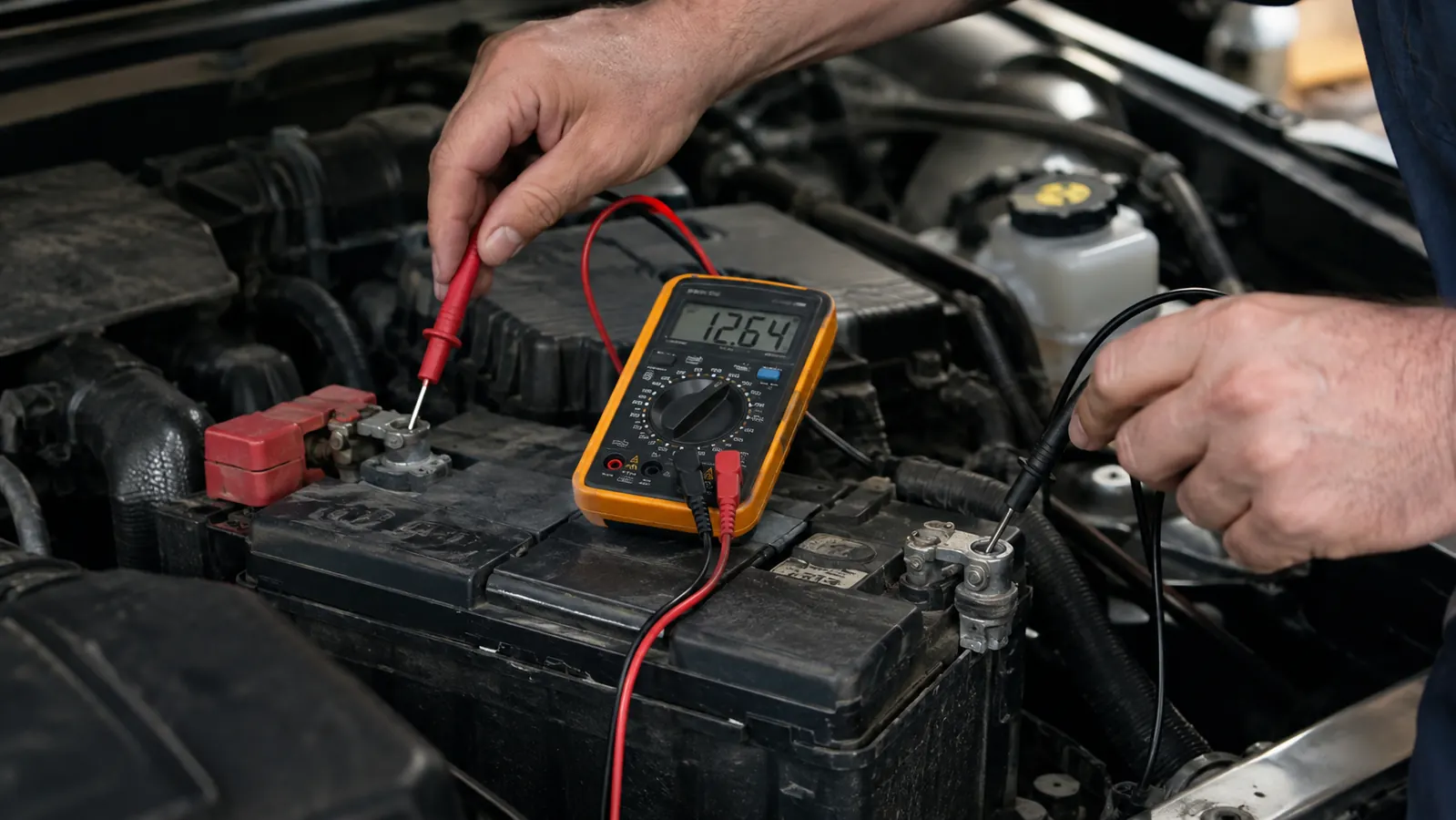
The one number I track is resting voltage. Before the maintainer, my truck battery would sit at about 12.2 volts after a few days and keep dropping. With the Genius1 connected, it sits at 12.7 to 12.8 volts, which is a fully charged 12-volt battery. That is the difference between a truck that starts and a truck that needs a jump.
I check it with a basic multimeter about once a month, after the truck has been off the maintainer for an hour. Since I started using the Genius1, it has read between 12.6 and 12.7 volts every time. That is a fully charged, healthy battery. If it ever starts reading 12.4 or lower after a full maintenance cycle, I will know the battery itself is wearing out and I will replace it on my schedule instead of the battery's.
Before the maintainer, my truck battery would sit at about 12.2 volts after a few days and keep dropping. With the NOCO Genius1 connected, it sits at 12.7 to 12.8 volts, which is a fully charged battery.
What I Like and What I Don't
What I Liked
- Set-and-forget operation: connect it, plug it in, ignore it
- Maintenance mode holds a battery at full charge without cooking it
- Spark-proof and reverse-polarity protected, which I tested on purpose
- Small enough to mount on a garage wall and forget about
- Works on 6V and 12V, flooded, AGM and gel batteries
- Brought my neighbor's drained 11.9-volt battery back to full
Where It Falls Short
- 1-amp output is slow for charging a deeply discharged battery
- The included clamps feel light and cheap compared to the rest of the unit
- The mode button and LED are easy to misread in bright sunlight
- No battery health readout, just a charging light
Who This Is For
The NOCO Genius1 is for anyone with a vehicle that sits. That includes a daily driver that only gets used a few times a week, a weekend car, a classic car, a motorcycle, a lawn tractor, or a boat that sits all winter. If your battery is healthy but drains when the vehicle is parked, this maintainer will keep it ready to go.
It is also for people who want to stop guessing. I used to wonder whether my battery was going to start the truck after a long stretch. Now I do not think about it. The Genius1 handles that job, and it does it without me having to remember to unplug it or worry about overcharging. That peace of mind is worth more than the price of the unit.
It is a good fit for anyone with a second vehicle that does not get driven much: a weekend car, a work truck that sits during vacation, a boat, a lawn tractor in winter, or a motorcycle. Because it handles both 6-volt and 12-volt batteries, it also covers older equipment. One maintainer that can move from vehicle to vehicle as the seasons change is a lot of use from a small box.
Who Should Skip It
If you need to charge a dead battery fast, the NOCO Genius1 is not the tool. At 1 amp, it can take a day or more to bring a deeply discharged battery back to a usable state. NOCO makes larger chargers with higher output for that job, and if you regularly deal with dead batteries, you want one of those instead.
Put plainly, this is a 1-amp charger. On a big truck battery that is truly flat, recharging it from empty would take more than a day. That is not what it is built for. If the battery is dead, jump the truck or use a bigger charger, drive it, and then let the Genius1 take over keeping it full. Used that way, it does exactly what it promises.
You should also skip it if you want a charger that tells you the battery's state of health. The Genius1 has a simple LED that shows charging, fully charged, or an error. It does not give you a voltage readout or a percentage. If you want data, you need a more expensive unit with a display.
The maintainer I leave on my truck between drives
After months of use, the NOCO Genius1 is the one I trust to keep my F-150 ready to start. If your battery drains when the vehicle sits, this is the fix.
Amazon Check Today's Price on Amazon →