
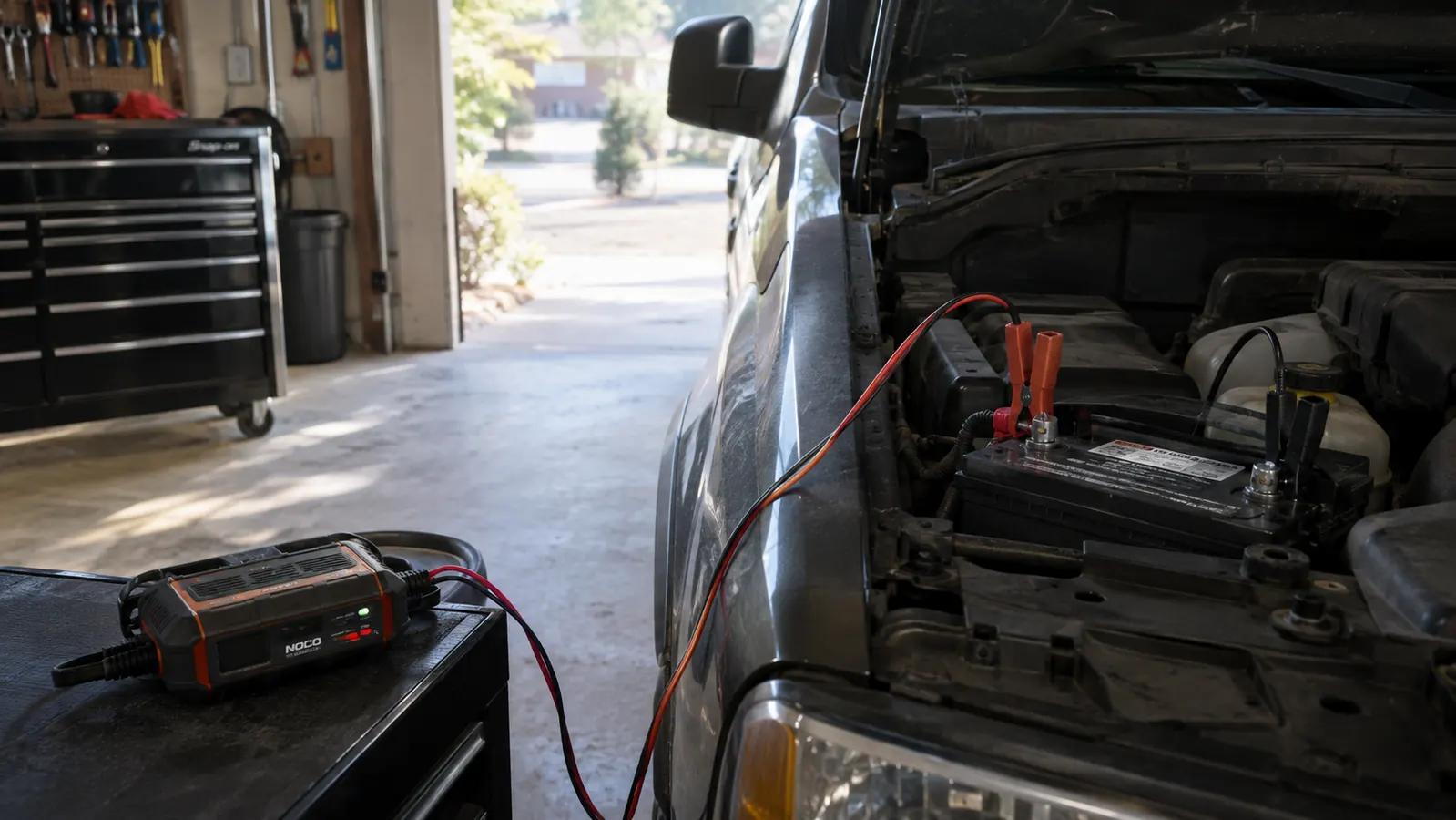
If you own a pickup that sits for a few days at a time, you already know the feeling. You walk out to the driveway, turn the key, and the starter drags like it is wading through mud. I have been doing my own brakes, oil, and small repairs in my driveway outside Dalton, Georgia for about 30 years, and I have killed more batteries than I care to count. So when I decided to finally buy a maintainer, I narrowed it down to two: the NOCO Genius1 and the Battery Tender Junior. I ran both on the same 2012 F-150, the same battery, and the same hot Georgia summer. Here is what I learned.
I tested both the simple way. The Battery Tender Junior went on my riding mower's battery and then on the truck, and the NOCO Genius1 did the same rotation, over a summer and into fall. I watched the lights, checked resting voltage with a multimeter, and paid attention to the small things that matter when you live with a charger: how easy it is to connect, how much it clutters the garage, and whether I ever had to think about it.
Why bother with a maintainer at all? Every modern vehicle draws a little power with the key off to keep the clock, radio presets and computer memory alive. Over a couple of weeks that slow drain can pull a battery down far enough that it struggles on a cold morning, and every deep drain shortens its life. A maintainer replaces that draw and keeps the battery full, which is the single easiest way I know to get an extra year or two out of one.
The short answer: the NOCO Genius1 is the one I kept hooked up. It is a 1-amp smart charger and maintainer that handles both 6-volt and 12-volt batteries, and it has a few features that matter more than the specs suggest. The Battery Tender Junior is a perfectly good maintainer, and for a narrow job it is hard to beat. But for a weekend mechanic who wants one tool that does more than sit on a shelf, the NOCO Genius1 wins.
Both are good products from companies that have been making battery chargers for a long time, and either one will keep a healthy 12-volt battery topped up far better than leaving it to sit. The differences are in the details, and depending on what you own, those details can make the decision for you.
| NOCO Genius1 | Battery Tender Junior | |
|---|---|---|
| Charging output | 1 amp, enough for a car or truck battery | 0.75 amp, a little slower on a bigger battery |
| Voltage support | 6V and 12V, so it covers motorcycles, ATVs, and cars | 12V only, fine for most cars but not small 6V batteries |
| Battery types | Flooded, AGM, gel, and lithium, with a mode for each | Flooded and AGM, no lithium mode |
| Force Mode for deeply drained batteries | A Force Mode that charges batteries drained too low for most smart chargers | No Force Mode |
| Ease of use | Plug in, clamp on, and it picks the right mode automatically | Plug in, clamp on, and it maintains. Simple, but less flexible |
| Price | Usually a few dollars more | Usually a few dollars less |
| Best for | A weekend mechanic with a truck, a mower, and maybe a boat or ATV | Someone with one car battery who wants a set-and-forget maintainer |
Where the NOCO Genius1 Wins
The first thing I noticed is that the NOCO Genius1 is not just a maintainer. It is a real charger. When I hooked it to a battery that had been sitting for a month, it brought it back to full instead of just keeping it from dying. The 1-amp output is modest, but it is enough for a standard truck battery, and the charger actually thinks. It reads the battery, picks the right profile, and adjusts as it goes. I did not have to flip any switches or guess at settings.
The Genius1 puts out about one amp. The Battery Tender Junior puts out about three quarters of an amp. On paper that is a small difference, and for maintaining a full battery it hardly matters. Where it shows up is recovery. When my truck battery was down to about 12.3 volts after a week of short trips, the Genius1 brought it back to full noticeably sooner. Neither is a fast charger, and neither should be used to bring back a truly dead battery in a hurry, but if the battery is a little low, the extra current helps.
Here is what that looked like in numbers. On a mid-August weekend I ran the riding mower battery down with the headlights until it read 12.1 volts, then put the Junior on it. It reached its green float light the next afternoon. I did the same thing the following weekend with the Genius1, and it reached full status a few hours sooner. Both got there, and both held the battery at a healthy resting voltage of about 12.7 afterward. The Junior was simply slower on the way up.
The other thing that sold me is the 6-volt support. I keep a small riding mower in the garage, and its battery is 6 volts. The Battery Tender Junior cannot touch it. The NOCO Genius1 handles it with the same clamps and the same automatic mode. That one feature turned one tool into the only charger I need for everything on my property. For a guy who works on his own stuff, that is the difference between a tool and a shelf ornament.
The Battery Tender Junior I tested is a 12-volt unit. Deltran makes other versions for 6-volt batteries, but that means a second charger. If everything you own runs on 12 volts, that does not matter. In my garage, where an older piece of equipment still uses a 6-volt battery, one charger that handles both and picks the right mode on its own is the kind of simple I appreciate.
The Genius1 also has a Force Mode for a battery that has drained so low a smart charger will not recognize it. Most smart chargers, including the Junior, need to see a minimum voltage before they start, as a safety measure. The NOCO lets you override that after you confirm the connection. I have used it once, on a mower battery that had sat all winter. It brought it back, though I would not count on that with a battery that has been flat for years.
Temperature compensation is the last big difference I care about. The Genius1 has a built in thermal sensor that adjusts its charge for the air temperature, which matters in a garage that runs from below freezing in January to the high nineties in July. Charging a battery the same way in both conditions either undercharges it in the cold or overcharges it in the heat. It is a small feature until you remember how hard a Georgia summer is on a battery.
The Junior handles heat and cold reasonably well, and its float mode keeps it from overcharging a full battery, which is the main thing an old trickle charger got wrong. But it does not adjust its voltage for temperature the way the NOCO does. In a climate-controlled garage, that hardly matters. In mine, which gets about as hot as the outside air in summer, I would rather have the charger that accounts for it.
One maintainer for the truck, the mower, and the ATV
The NOCO Genius1 handles 6V and 12V batteries, picks the right mode automatically, and has a Force Mode for batteries drained too low for most chargers to detect. That is the one I kept hooked up in my garage.
Amazon Check Today's Price on Amazon →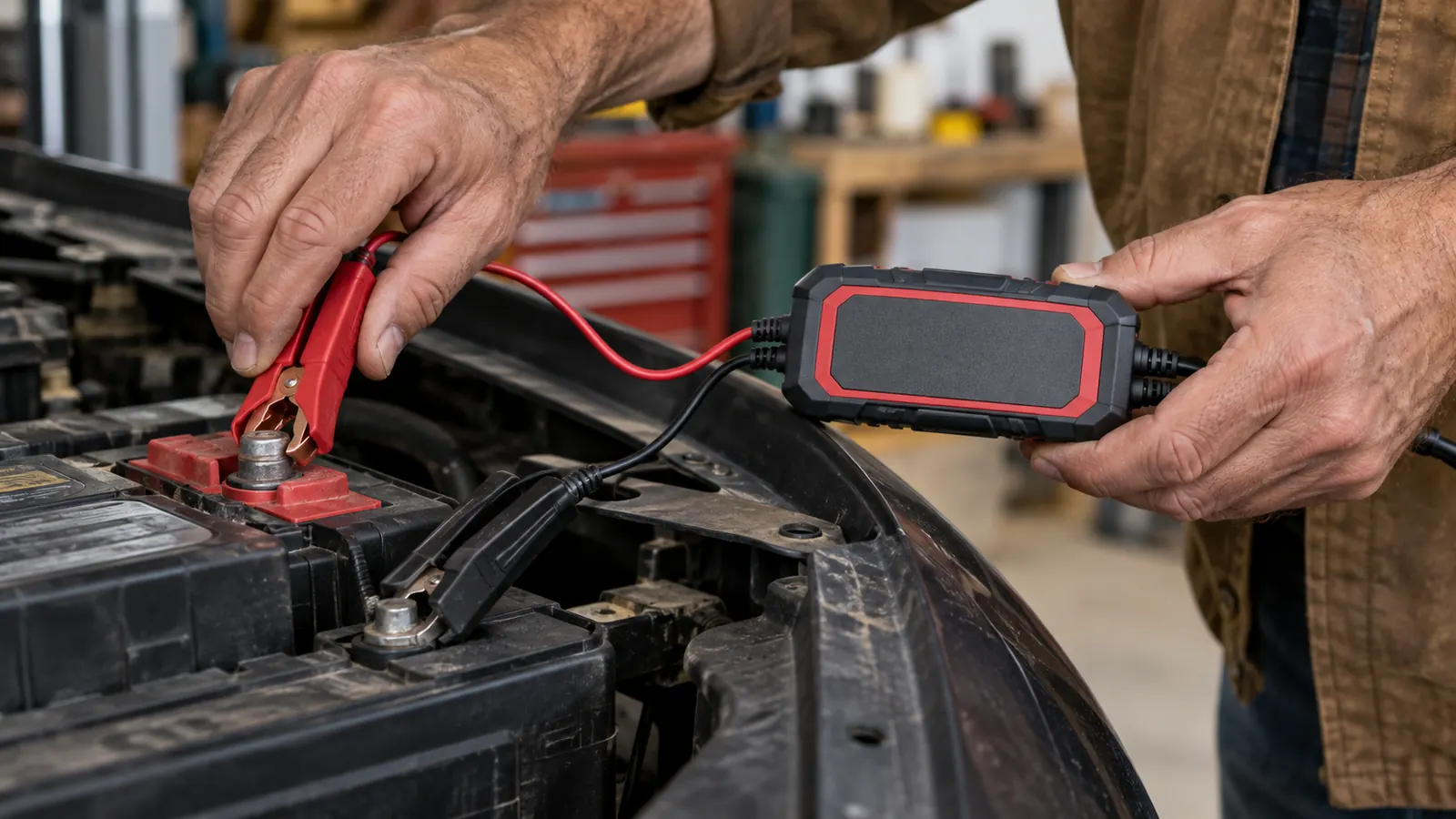
Where the Battery Tender Junior Wins
I am not going to pretend the Battery Tender Junior is a bad product. It is not. It has been the default maintainer for a lot of people for a long time, and there is a reason for that. It is dead simple. You plug it in, clamp it on, and it does its job. If you have one car and you just want to keep the battery from going flat over the winter, it will do that all season without you thinking about it. It is also usually a few dollars cheaper, and for a single-purpose tool, that price difference is real.
It is also simple in a way I respect. One light shows red while it charges and green when it has switched to float. That is the entire interface. There is nothing to misread, and it has been around long enough that plenty of motorcyclists and classic car owners have one hanging on the garage wall that has worked for years. If a friend asked me whether the Junior would keep his motorcycle battery healthy over winter, the answer is yes.
The Junior is also a little smaller and lighter, which matters if you are packing it in a camper or a boat. And its cable is plenty long for most garage setups. I used it for a few weeks on my truck before I switched to the NOCO, and it held the battery fine. It just did not do anything else. When I wanted to charge a deeply discharged battery or hook up a 6-volt mower battery, I had to reach for a different tool. If your world is one 12-volt car battery, the Junior is a perfectly honest choice.
Both come with clamps and a set of ring terminals you can leave bolted to the battery, so connecting either one is a matter of plugging in a lead. That makes both easy to live with on a vehicle you park often. I found the NOCO's connector a little sturdier and its cords a bit more flexible in cold weather, but those are small differences you would only notice side by side.
Price is where the Junior gets a real edge. It usually costs less than the Genius1, and if you need one maintainer on each of several vehicles, the savings add up. For a single motorcycle or a car that sits in a mild climate, you may not get your money's worth out of the NOCO's extra features, and the Junior will keep the battery healthy just the same.
Who Should Buy Which
Buy the NOCO Genius1 if you are anything like me: a weekend mechanic with more than one vehicle, a mower, or a project that sits for months. The 6-volt support, the lithium mode, and the repair function make it a tool you will actually use, not just a thing that hangs on a pegboard. It costs a little more, but it replaces several other tools.
That includes anyone who parks a vehicle for a few weeks at a time in a garage that sees real heat and cold, anyone who owns a mix of 6-volt and 12-volt batteries, and anyone who wants a little more charging current for a battery that is low but not dead. It is the more capable of the two, and in my garage that capability gets used.
Buy the Battery Tender Junior if you have exactly one 12-volt battery and you want the cheapest reliable way to keep it topped up. It is a good product. It is just a narrower product. For my money, the NOCO Genius1 is the better buy for a weekend mechanic, and it is the one I recommend to the neighbors who ask.
It is also a fine choice if you want the most basic, proven option and do not care about extra modes. For a motorcycle that sits all winter in a mild garage, the Junior does the job and asks nothing of you. You would not be wrong to buy it.
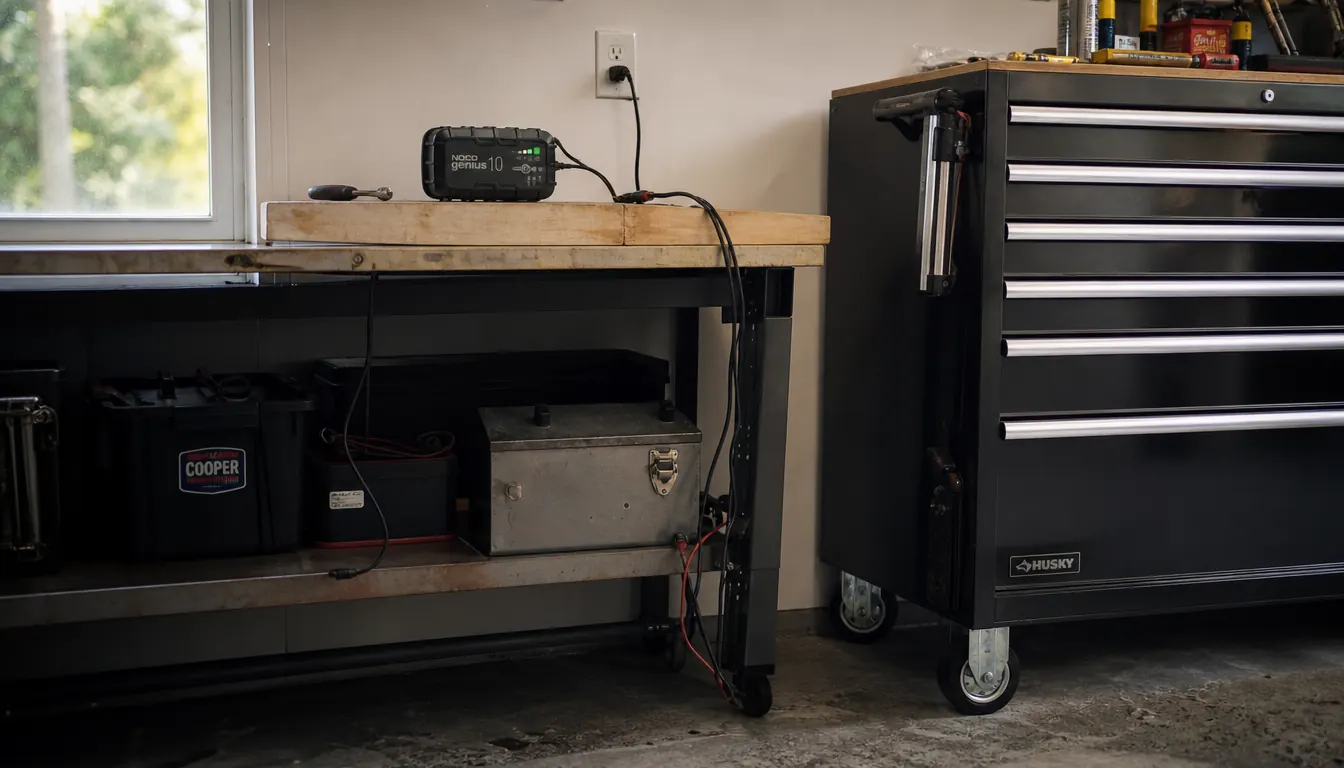
Whichever you choose, the habit is what saves the battery. A maintainer only works if it is plugged in when the vehicle sits. Mount it on the wall near where you park, leave the ring terminals on the battery, and make connecting it as easy as hanging up your keys. The best charger in the world will not help a battery it is sitting next to on the shelf.
The maintainer I kept in my garage
After a full summer of testing both, the NOCO Genius1 is the one still hooked up to my truck. If you want one tool that covers every battery you own, this is it.
Amazon Check Today's Price on Amazon →