
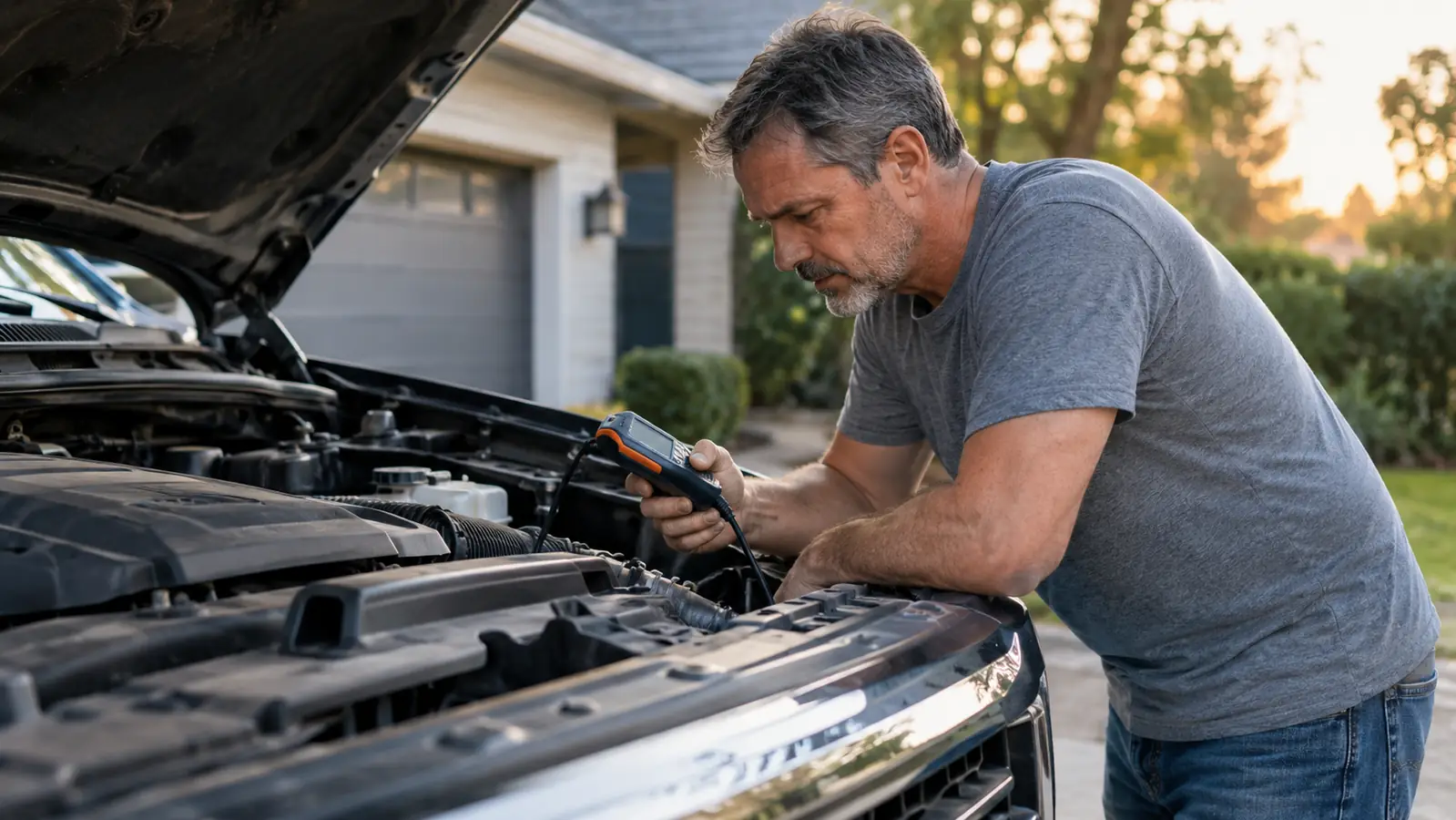
I have been turning wrenches in my driveway outside Dalton, Georgia for about thirty years, and I will tell you straight: I bought the ANCEL AD310 because it was cheap and because the check engine light on my 2012 F-150 with 187,000 miles had come on for the third time in a month. I did not expect much. A budget code reader that plugs into the port under the dash and tells you what is wrong? I have seen plenty of those come and go. What I did not expect was that six months later, it would still be the first tool I grab when a neighbor knocks on the door with a glowing dashboard.
This is the honest version of that story. The AD310 is not a professional scan tool, it is not a replacement for a shop, and it will not tell you everything. But for a weekend mechanic who just wants to know whether the problem is a loose gas cap or a failing sensor, it does the job better than anything else at its price. Here is what I learned using it on my own truck and on a handful of neighbors' cars over the last six months.
The Quick Verdict
The ANCEL AD310 is the best cheap OBD2 scanner I have used in thirty years of driveway wrenching. It reads and clears codes on any 1996 or newer vehicle, it is built tough enough to survive a Georgia summer in a tool box, and it pays for itself the first time it stops you from buying a part you do not need. It will not show live data or manufacturer-specific codes, so if you need those, spend more. If you just need to know what the light means, buy this one.
Amazon Check Today's Price →Stop guessing what that check engine light means
The ANCEL AD310 reads and clears engine codes on any 1996 or newer vehicle in about thirty seconds. It is the first tool I grab when a light comes on in my driveway.
Amazon Check Today's Price on Amazon →How I've Used It
I have owned the AD310 for about six months. In that time I have used it on my 2012 F-150, my neighbor's sedan, my brother-in-law's SUV, and a friend's older coupe. That is the thing about a code reader: once people know you have one, you become the neighborhood diagnostic station. I have read codes for a loose gas cap, a bad oxygen sensor, a failing thermostat, and a misfire that turned out to be a worn spark plug wire. In every case, the AD310 gave me the code, I looked it up, and I decided whether the fix was something I wanted to tackle in the driveway or something that needed a shop.
The unit itself is small, about the size of a deck of cards, with a two-line monochrome display and six buttons. There is no touchscreen, no color screen, no Bluetooth, no app. That sounds like a list of complaints, but for my money it is a list of reasons the thing still works after six months of being thrown in a tool box, dropped on concrete, and left in a truck cab in July. Simple tools survive. Fancy ones break.
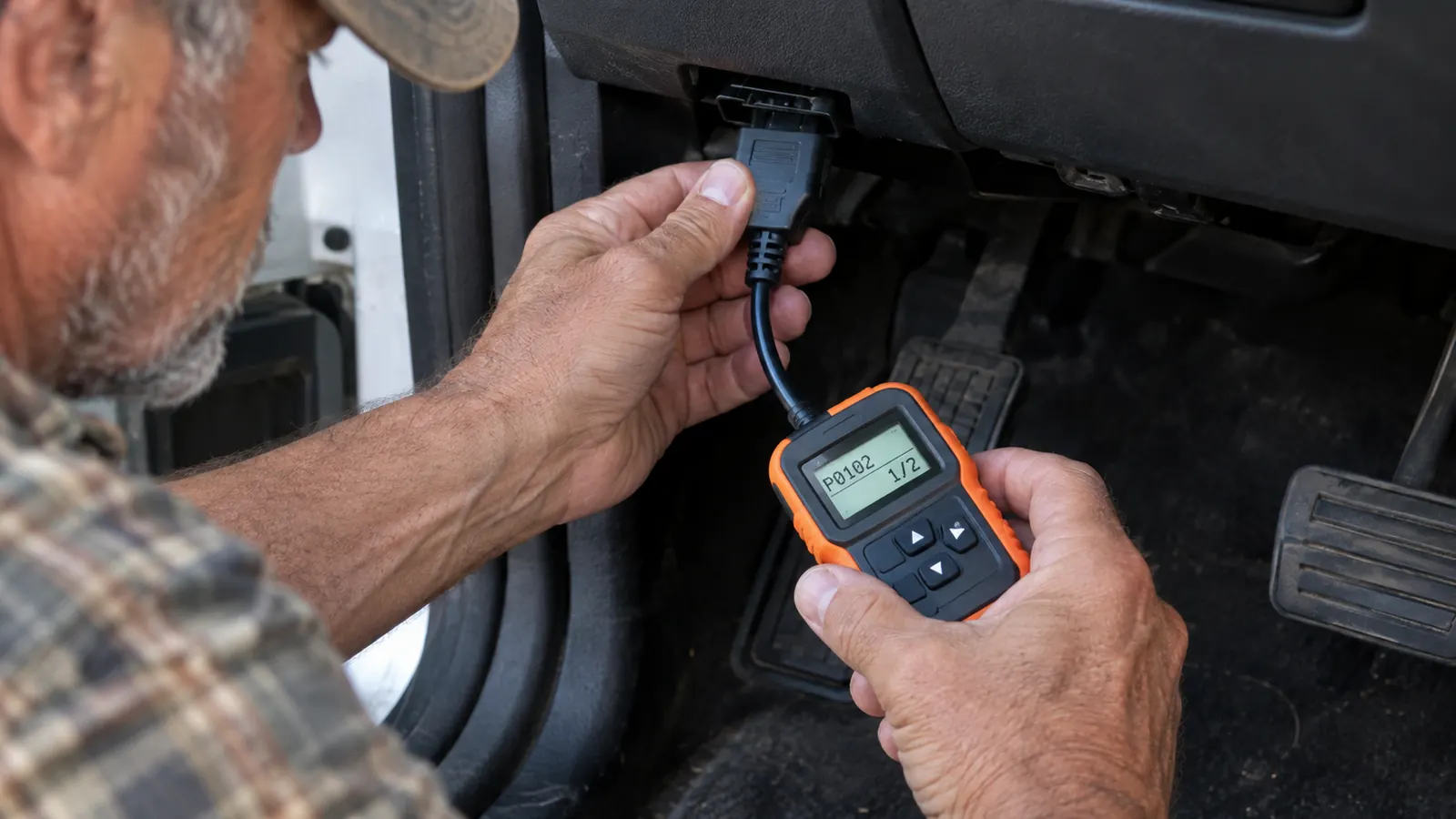
The first time I used it, I plugged it into the port under the dash, turned the key, and waited. Within a few seconds the screen lit up with the code P0442, a small evaporative emissions leak. I cleared the code, tightened the gas cap, and it did not come back. That one fix paid for the scanner. The second time, it read a P0420 on my truck, which sent me down a rabbit hole of catalytic converter research before I realized the real problem was a slow oxygen sensor. The AD310 did not diagnose the root cause for me. It gave me the code, and I did the thinking. That is the honest deal with a tool like this.
That first code was a P0455, a large evaporative emissions leak. The AD310 showed the code and a short line of text, and that was all it needed to do. I looked it up, checked the obvious suspect first, and found the gas cap seal cracked and flattened on one side from years of being cranked down too hard. A new cap cost less than a tank of gas. I cleared the code with the scanner, drove the truck for four days of normal errands, and the light stayed off. Before I owned a code reader, I would have paid a shop to plug in, or bought a part on a guess. A loose or worn gas cap is one of the most common reasons that light comes on, and it is a five minute fix once you know.
What the ANCEL AD310 Does Well
The first thing you notice is how fast it reads. Plug it in, turn the key, and you have a code in under ten seconds. My old scanner took thirty seconds to boot up and sometimes needed two tries. The AD310 just works. It reads generic powertrain codes on any 1996 or newer vehicle that speaks OBD2, which is every car and light truck sold in the United States for the last twenty-five years. That includes my 2012 F-150, my neighbor's sedan, and the 1998 coupe my friend still drives on weekends.
The second thing is the clear function. You can erase the code after you fix the problem, which sounds obvious but is not universal at this price. Some cheap readers will show you a code and then make you pay extra or buy a second device to clear it. The AD310 clears codes with two button presses. That matters when you have fixed a loose gas cap and you want to know whether the light stays off.
The third thing is build quality. The housing is a thick plastic shell with a rubberized grip, and the cable is about a foot long with a sturdy connector. I have dropped it on concrete twice. It still works. I have left it in the truck in July, when the inside of a closed cab in north Georgia can push past 130 degrees. It still works. I have loaned it to a neighbor who plugged it in backwards, which is hard to do but he managed it. It still works. For a tool that costs less than a tank of gas, that is the kind of durability I respect.
The fourth thing, and the one that matters most to a driveway mechanic, is that it stops you from throwing parts at a problem. Before I owned a code reader, I replaced a crankshaft position sensor on an old car because a friend swore that was the problem. It was not the problem. The fix took one part and an afternoon. With the AD310, I read the actual code, look it up, and make a decision based on data instead of a guess. That alone has saved me more than the scanner cost in the first month.
The AD310 paid for itself the first time it stopped me from buying a part I did not need. That is the whole argument for owning one.
Where It Falls Short
Now the part of the review that sounds like I am trying to talk you out of it. The AD310 only reads generic powertrain codes. It will not read manufacturer-specific codes, which is where a lot of real problems live on modern cars. On my 2012 F-150, for example, Ford has a whole set of proprietary codes that a generic reader cannot see. If your problem is in the transmission, the ABS, the airbags, or the body control module, the AD310 will often show you nothing at all. It is an engine code reader, not a full diagnostic tool.
It also has no live data. That is the feature I miss the most. Live data is the stream of sensor readings, engine RPM, coolant temperature, fuel trim, and oxygen sensor voltage that updates in real time while the engine runs. A scanner with live data can show you whether a sensor is drifting out of range before it fails completely. The AD310 cannot do that. It gives you a snapshot, not a movie. For a weekend mechanic, that is the difference between knowing a code exists and understanding what is actually happening.
What that means in practice: when my neighbor's sedan threw a lean code, the AD310 told me the code and nothing more. I could not watch the fuel trims move or see the oxygen sensor switching. I ended up borrowing a friend's app-based scanner to confirm it was a cracked intake hose and not a sensor. That is the honest ceiling of this tool. It tells you where to start looking, and for most of what happens to an older daily driver, that is enough. When it is not enough, you will know, because the code points at something that could have three or four different causes and you need more information to choose.
The screen is another honest limitation. It is a two-line monochrome display that shows the code and a short description. It is perfectly readable in daylight, but it is small, and if you are under forty you will probably find yourself squinting. I am fifty-two and I keep a pair of reading glasses in the tool box for exactly this reason. The buttons are also a little stiff, which is fine when you are pressing them once, but annoying when you are scrolling through a list of codes.
And there is one thing nobody tells you about cheap code readers: they only speak OBD2. If you have a 1995 or older vehicle, or a vehicle that uses a different protocol, the AD310 will not help you. That is not a flaw in the scanner, it is a limitation of the standard, but it is worth knowing before you buy one for a classic car project.
What I Liked
- Reads and clears check engine codes on 1996 and newer OBD2 vehicles in under a minute
- No app, no battery, no pairing: it powers from the port
- Tough shell that has survived drops, summer heat and a winter in the truck
- Simple enough that a first-timer can use it without the manual
Where It Falls Short
- No live data, so it cannot watch sensors in real time
- Small two-line screen that is hard to read in direct sun
- Engine codes only: it will not read ABS, airbag or transmission modules
- Short code descriptions, so you still look codes up online
The Codes I Actually Read
Over six months, I have read and cleared codes on five different vehicles. Here is the list, because I think real-world examples tell you more than a spec sheet. On my F-150, I read P0442, a small evaporative emissions leak, which turned out to be a loose gas cap. I read P0420, catalyst system efficiency below threshold, which turned out to be a slow oxygen sensor. I read P0301, cylinder one misfire, which turned out to be a worn spark plug wire. On my neighbor's sedan, I read P0128, coolant thermostat below regulating temperature, which meant the thermostat was stuck open. On my brother-in-law's SUV, I read P0171, system too lean, which turned out to be a vacuum leak in a cracked hose.
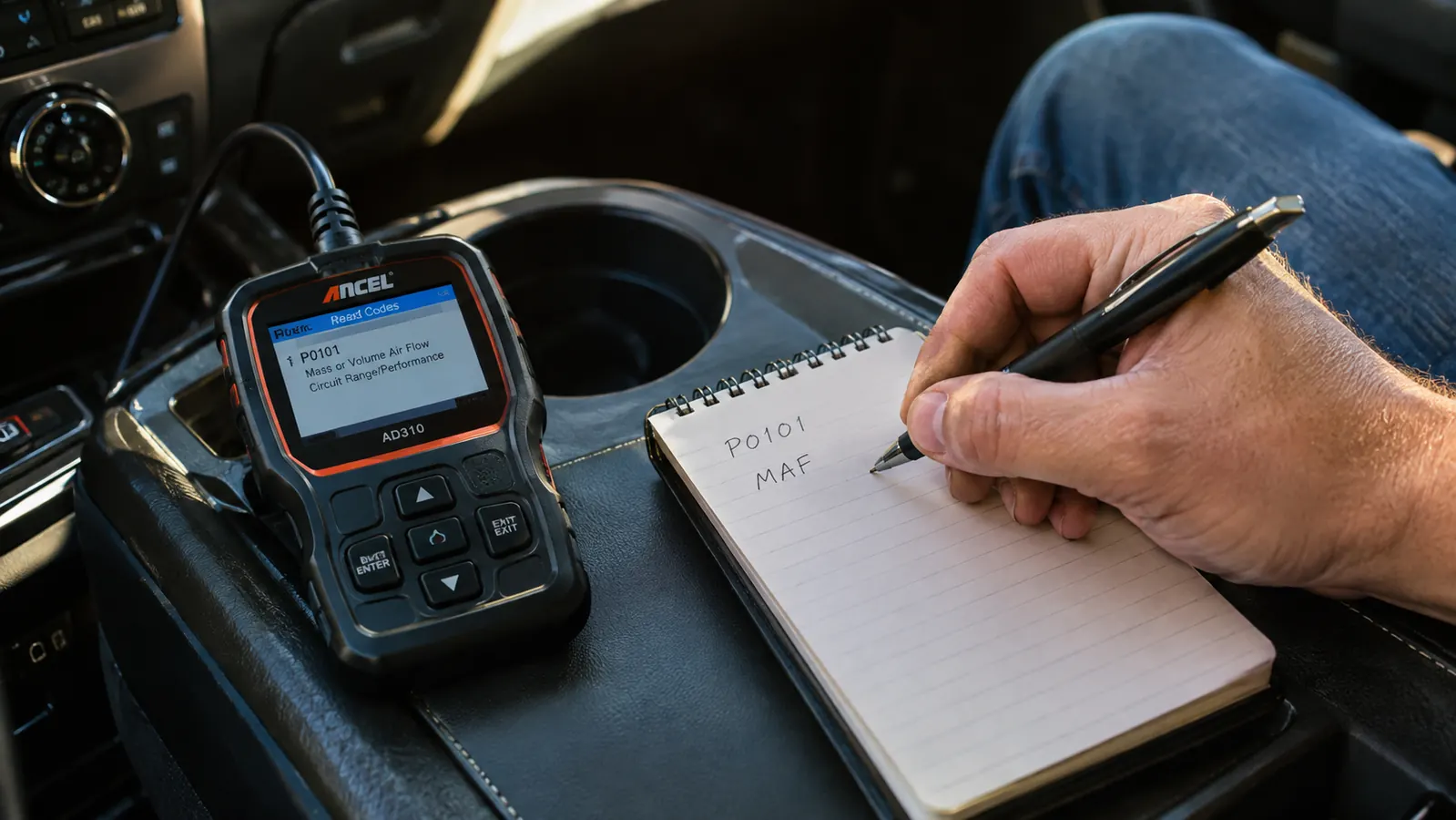
In every case, the AD310 gave me the code, I looked it up, and I decided whether the fix was something I wanted to tackle in the driveway or something that needed a shop. The scanner did not do the diagnosis for me. It did the part that matters most: it told me where to look. That is the honest value of a code reader. It is not a mechanic in a box. It is a flashlight that points at the problem.
Who This Is For
The ANCEL AD310 is for the person who changes their own oil, does their own brakes, and has stared at a check engine light wondering whether they can ignore it for another week. It is for the person who has been burned by a shop charging an hour of labor to read a code that turned out to be a loose gas cap. It is for the person who wants to know, before they buy a part, whether the part is actually the problem. If that sounds like you, this scanner will pay for itself the first time you use it.
It is also for the person who wants a tool that will still work in five years. There is no software to update, no app to maintain, no subscription to cancel. The AD310 is a dumb tool in the best sense of the word. It does one thing, it does it well, and it does not need a firmware update to keep doing it. In a world where everything wants a monthly fee, that is worth something.
Who Should Skip It
If you are a professional mechanic, or if you work on modern cars with complex electrical systems, the AD310 is not for you. You need live data, manufacturer-specific codes, and the ability to read modules beyond the engine. You should buy a professional scan tool, and you should expect to pay for it. The AD310 is not a substitute for that, and anyone who tells you otherwise is selling something.
If you have a 1995 or older vehicle, or a vehicle that does not speak OBD2, skip it. If you want to graph sensor data on your phone, skip it. If you want a scanner that will tell you exactly which part to replace, skip it, because no code reader does that, and anyone who claims otherwise is lying. The AD310 gives you the code. You still have to do the thinking.
What I'd Tell a Neighbor
If a neighbor leaned on my fender and asked whether the AD310 was worth it, I would say yes, with one caveat. Buy it for what it is: a cheap, reliable, no-nonsense way to read and clear engine codes. Do not buy it expecting a full diagnostic tool. If you want live data and manufacturer-specific codes, spend three times as much and get a scanner that does those things. But if you just want to know why the light is on, and you want to know it in the next thirty seconds, the AD310 is the best money you will spend in your tool box.
I have owned mine for six months. It has been dropped, baked, loaned out, and used on five different vehicles. It still reads codes in under ten seconds, it still clears them with two button presses, and it still fits in the drawer of my rolling tool chest. I do not say that about many tools. The ANCEL AD310 is one of them.
The scanner I keep in my tool box
Six months in, the ANCEL AD310 is still the first tool I grab when a check engine light comes on. It reads and clears codes on any 1996 or newer vehicle.
Amazon Check Today's Price on Amazon →