
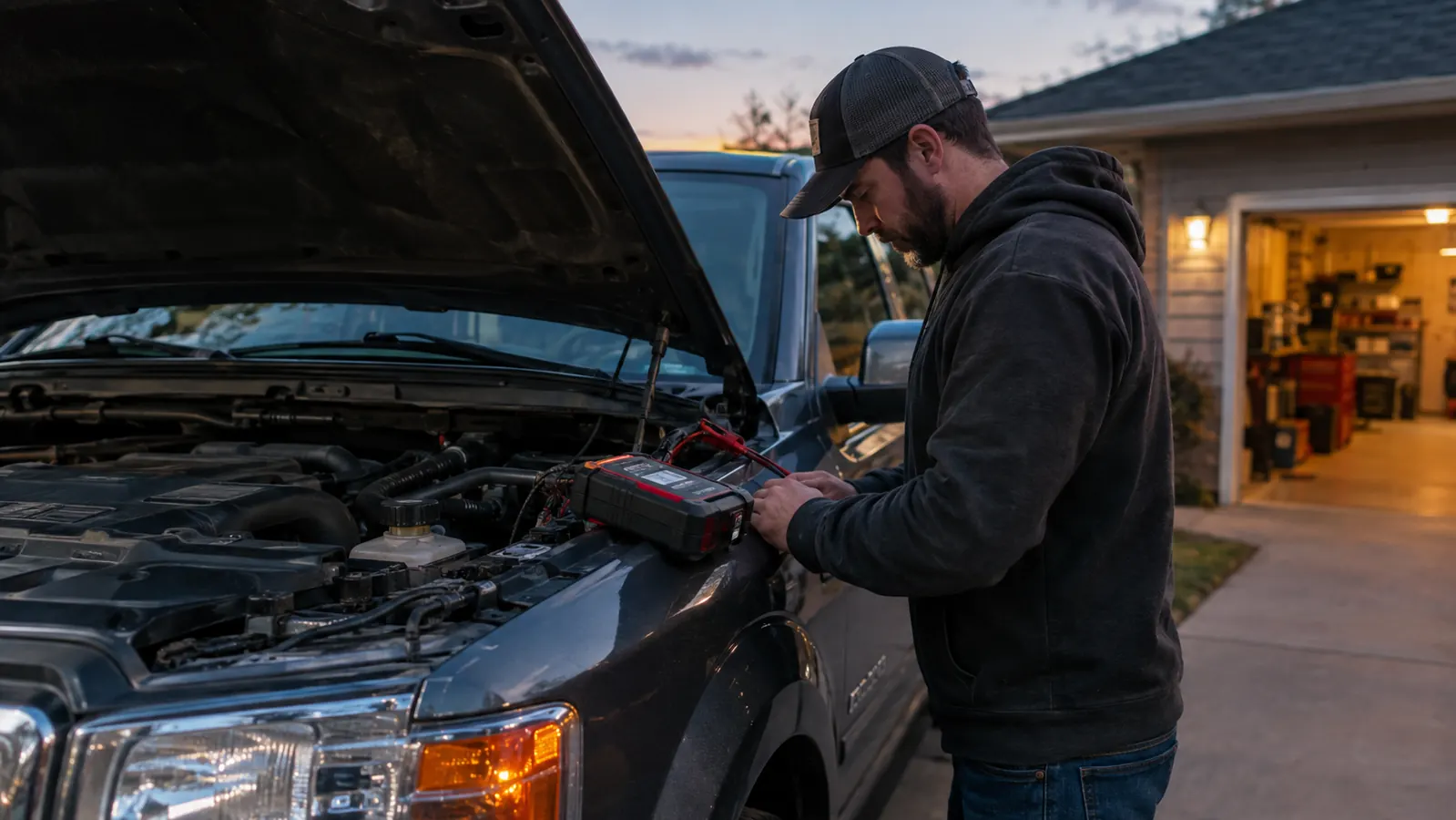
A dead battery is never convenient. It is usually cold, or dark, or you are already late, and the truck just clicks when you turn the key. I have been doing my own work in the driveway outside Dalton for about 30 years, and for most of that time my answer was a set of jumper cables and a neighbor willing to pull up close. Then I bought the NOCO Boost GB40, and I have not asked a neighbor for a jump since.
This is the walkthrough I wish someone had handed me the first time. It covers where to clamp, what order to connect things, how long to wait, and the mistakes that will make a jump start take twice as long or damage something. The NOCO Boost GB40 is the jump starter I keep in my 2012 F-150, and it has started that truck more times than I want to admit.
The jump starter that lives in my truck
The NOCO Boost GB40 is the compact lithium jump starter I reach for first. It has started my F-150 and a neighbor's sedan without a second vehicle in sight.
Amazon Check Today's Price on Amazon →Step 1: Park, set the brake, and open the hood
Put the vehicle in park, set the parking brake, and turn everything off. That means the ignition, the headlights, the radio, the cabin fan, everything. A jump starter is not a magic wand, and it works a lot better when the dead vehicle is not asking the battery to do anything else.
Open the hood and find the battery. On my 2012 F-150 it is on the passenger side, but on a lot of cars it is under a plastic cover or tucked behind a fuse box. If you cannot see the battery clearly, look for the red positive cap. That is the terminal you need first.
One thing I do before anything else: I check the battery for damage. If the case is cracked, swollen, or leaking, do not mess with it. Call a shop. A damaged battery can vent hydrogen gas, and a spark from a clamp is all it takes. That is not me being dramatic, that is the safety lecture I give every neighbor who watches me do this.
A specific example: last February my neighbor's sedan would not crank on a wet morning, and when I opened the hood the battery case had a hairline crack along the top edge and a faint smell of sulfur. I closed the hood, told him to call a shop, and did not even unpack the NOCO Boost GB40. A jump starter is not worth a face full of battery acid. If the battery looks wrong, the battery is wrong.
Step 2: Charge the NOCO Boost GB40 before you need it
The NOCO Boost GB40 runs on a lithium battery, and lithium batteries do not like being stored dead. When the GB40 arrives, charge it fully before you trust it. The box says to charge it for a few hours, and I have found that a full charge is the difference between a jump start that works and one that clicks.
I keep mine in the truck, and I check it about once a month. The GB40 has a charge indicator on the side, so I can see the level without plugging it in. If it drops below half, I bring it inside and top it off. A jump starter that sits at zero percent is just a paperweight with a handle.
The GB40 is rated at 1000 amps, which sounds like a lot, and for a standard pickup or sedan it is plenty. It will not start a diesel work truck or a big commercial rig, and NOCO does not claim it will. For the vehicles most of us actually drive, it has never let me down.
The first time I used it, I made the mistake of trusting it straight out of the box. The unit had been sitting on a shelf for a couple of months, the indicator showed about a quarter charge, and my truck clicked instead of cranking. I brought the GB40 inside, charged it for four hours, and the next morning it started the truck on the first try. Now I treat the charge indicator like a fuel gauge: if it is below half, it gets topped off before it goes back in the truck.
Step 3: Connect the red clamp first, then the black
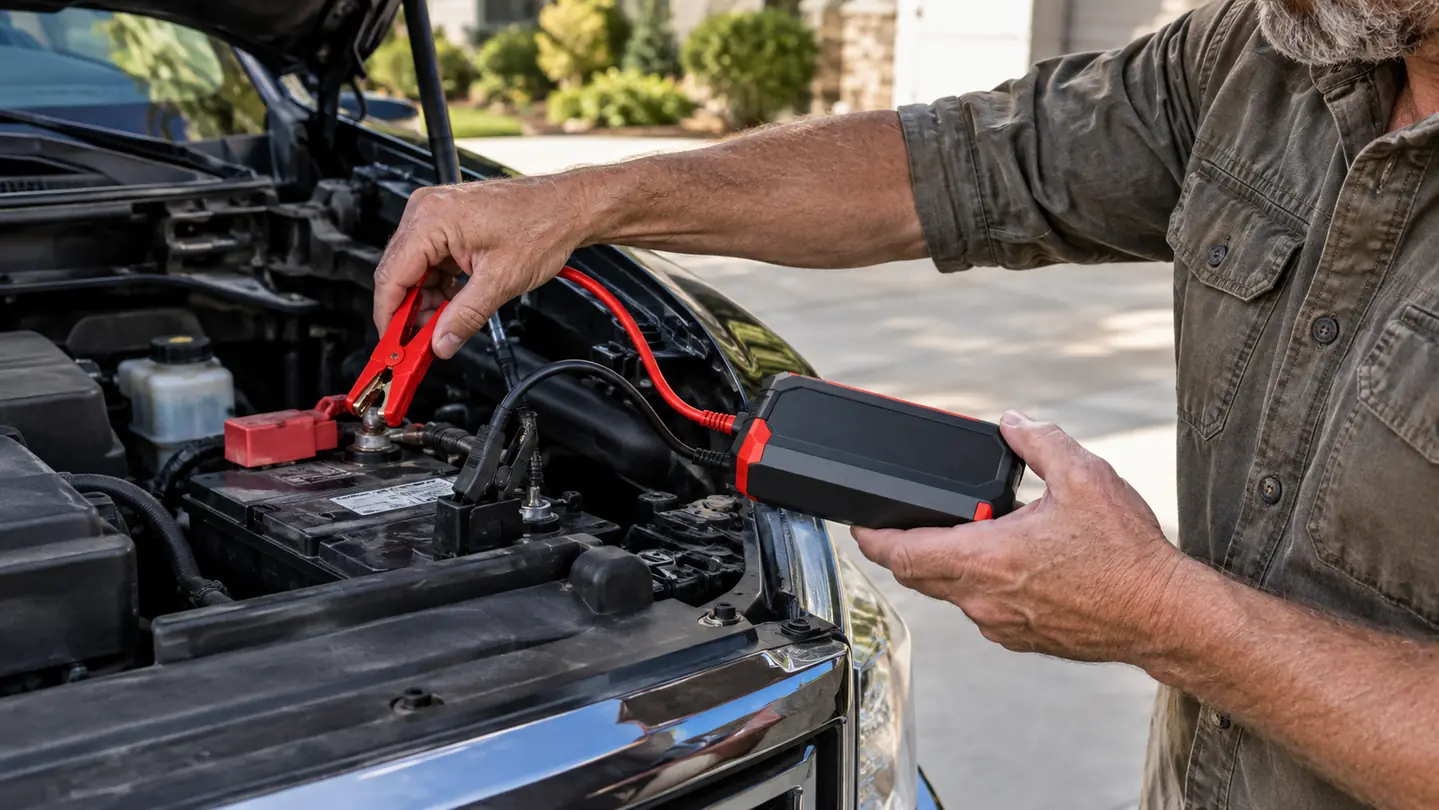
The order matters. Connect the red clamp to the positive terminal of the dead battery first. The positive terminal is the one with the red cap or the plus sign. On my F-150 it is easy to reach, but on some cars you have to wiggle the clamp a little to get a solid bite. You want the clamp to grab metal, not the plastic cover.
Then connect the black clamp. Here is the part that confuses people: you do not clamp the black lead to the negative battery terminal. You clamp it to bare metal on the engine block or the frame, a few inches away from the battery. That is called a ground point, and it is the safe way to do it. The NOCO Boost GB40 has a built-in spark protection feature, so it is more forgiving than a raw set of cables, but good habits still matter.
If you cannot find a good ground point, look for a bolt or a bracket on the engine that is not painted. Paint does not conduct well. I have used the alternator bracket on my truck more than once. Just keep the black clamp away from the battery itself, and away from anything that moves.
On my truck the alternator bracket sits low on the passenger side, and I have to reach past the belt to get the clamp on it. The first time I did it, I clipped the edge of the belt with the clamp and it made a thump as it let go. Now I angle the clamp from below and seat it against the flat part of the bracket. It takes an extra five seconds, and it beats fishing a clamp out from behind a spinning belt.
Step 4: Turn on the GB40 and start the vehicle
Once both clamps are connected, press the power button on the NOCO Boost GB40. The unit has a light that shows it is on, and some versions have a manual boost mode for when the battery is completely dead. If the vehicle does not start right away, wait a minute or two and try again. The GB40 is pushing power into the battery the whole time it is connected.
When you turn the key, the engine should crank like the battery was never dead. If it cranks slow, give it another minute. If it cranks fast but will not fire, the problem is probably not the battery, and a jump starter will not fix a bad fuel pump or a dead alternator. The GB40 is a battery booster, not a mechanic.
Once the engine is running, leave the GB40 connected for another minute or two. That lets the alternator take over and gives the battery a little time to recover. Then disconnect in the reverse order: black clamp first, then red. Put the GB40 back in its case and charge it when you get home, because the next time you need it, you will need it to be ready.
One morning last spring I went out to leave for work and the truck would not even click. No dash lights, no dome light, nothing. I connected the GB40, waited about ninety seconds with the unit on, and the truck fired up like it was a warm afternoon. That was the moment I stopped carrying jumper cables in the truck bed. The cables are still in the garage somewhere, and I have not needed them since.
Step 5: Let the vehicle run, then test the battery
Do not shut the engine off right away. A battery that just went dead needs time to take a charge from the alternator. I let the vehicle run for at least 15 minutes, and if I am in a hurry, I drive it for a while instead of idling. The alternator does more work at driving speed than at idle.
After the vehicle has run, turn it off and try to start it again. If it starts, the battery is probably fine and the dead battery was just a one-time event, maybe from leaving the lights on. If it clicks again, the battery is likely on its way out, and a jump starter will keep rescuing you until you replace it. That is what happened with my truck's original battery, and the NOCO Boost GB40 bought me a few extra weeks until I could get to the parts store.
If the battery is more than four or five years old, do not be surprised if it needs replacing. A jump starter is a tool for getting you going, not a cure for a battery that has reached the end of its life. I have replaced a lot of batteries in my driveway, and the GB40 makes the whole process easier because I do not have to push the truck out of the garage to get a jump from someone else.
When my truck's original battery finally gave out, it was a Tuesday afternoon in August, about 95 degrees in the shade. I jumped it with the GB40, drove to the parts store, and had a new battery in before supper. The old battery was six years old and had been slow to crank on cold mornings for months. The jump starter did its job, but the battery was done, and no amount of boosting was going to change that.
What Else Helps
A jump starter is the main tool, but a few other things make the job easier. A pair of work gloves protects your hands from grime and from a hot engine block. A small wire brush cleans corrosion off the battery terminals, because a jump starter cannot make a good connection through a layer of white crust. And a basic multimeter, which costs less than a tank of gas, tells you whether the battery is actually holding a charge or just pretending to.
I also keep the NOCO Boost GB40 in the truck year round, including through north Georgia summers. Heat is hard on batteries, and a battery that dies in July is just as dead as one that dies in January. The GB40 has held up fine in the heat, and it has never swollen or failed to hold a charge, which is more than I can say for some cheap boosters I have seen.
One more thing: read the manual that comes with the GB40. It is short, and it covers the specific lights and buttons on the unit. I know most of us skip the manual, but with a jump starter, the difference between a good experience and a frustrating one is usually a single button you did not know existed.
The NOCO Boost GB40 has started my F-150 more times than I want to admit, and it has never once needed a second vehicle to do it.
Keep one in your truck before you need it
The NOCO Boost GB40 is the jump starter I trust in my own driveway. It sits in my F-150 year round, and it has paid for itself many times over.
Amazon Check Today's Price on Amazon →