
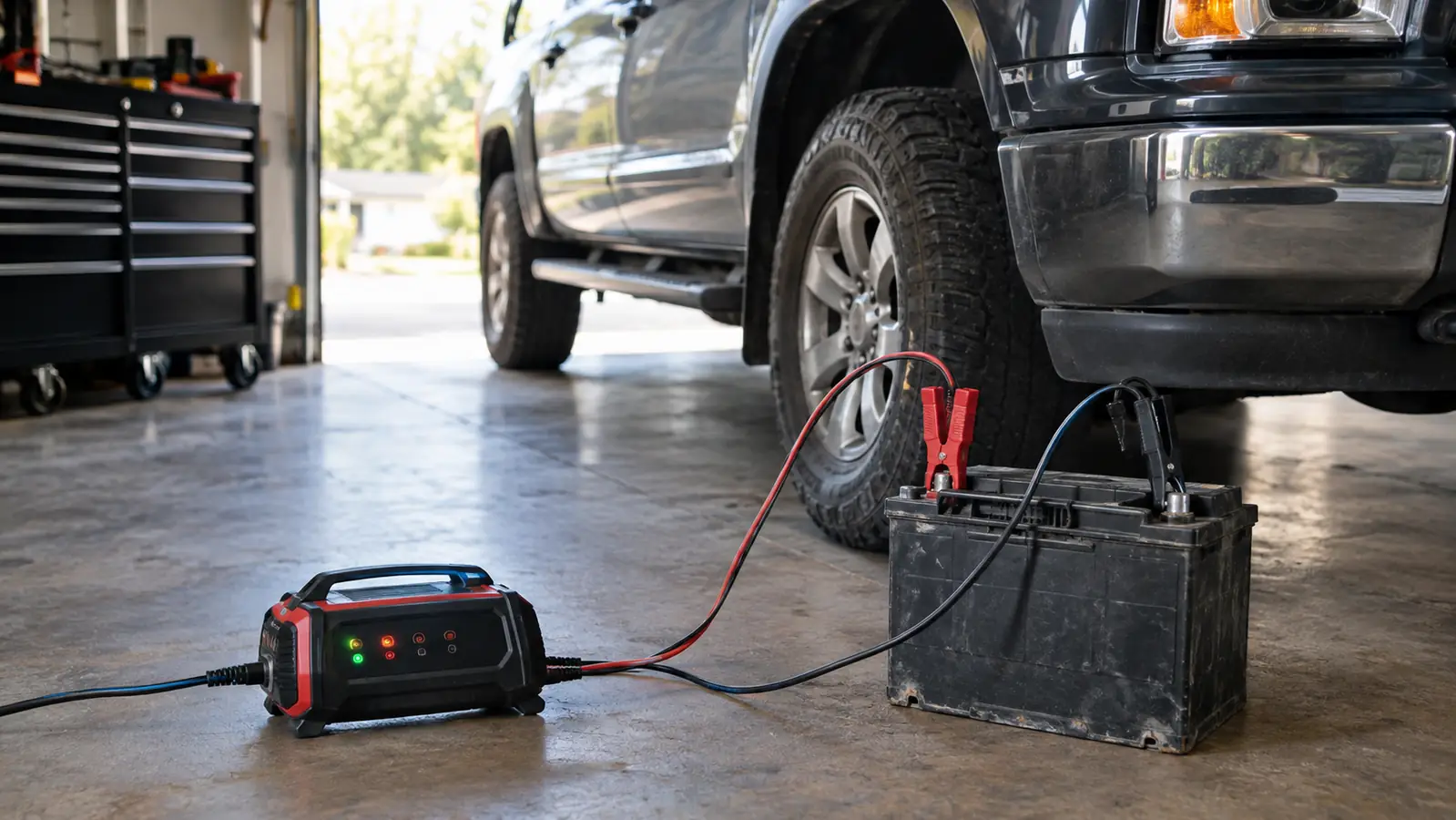
I will start with the part that surprised me. I bought the NOCO Genius1 mostly because my 2012 F-150 sits for a week at a time while I am working on other people's cars, and the factory battery was starting to sound tired on cold mornings. I expected a trickle charger that would keep the battery from going flat. What I did not expect was for a small box of electronics to be the most useful tool in my garage all winter.
Here is the honest part. The NOCO Genius1 is not a fast charger, it is not a jump starter, and it will not resurrect a battery that is already dead. If you are picturing a device that does everything, you will be disappointed. If you need something that keeps a good battery good, and does it without you thinking about it, this is the one I reach for.
The Quick Verdict
The NOCO Genius1 is the best slow maintainer I have used for the money, as long as you understand it is a maintainer first and a charger second.
Amazon Check Today's Price →Keep your battery from dying while the truck sits
The NOCO Genius1 is the maintainer I leave clamped on my F-150 all winter. It keeps the battery topped off, and it does not overcharge it.
Amazon Check Today's Price on Amazon →How I've Used It
I have owned the NOCO Genius1 for about eight months. It has been through a north Georgia winter with nights in the teens, a spring where the truck sat for two weeks while I was out of town, and a summer where the garage regularly hits the high 90s. The same battery that was struggling in November is still cranking the truck today. That is the whole review in one sentence.
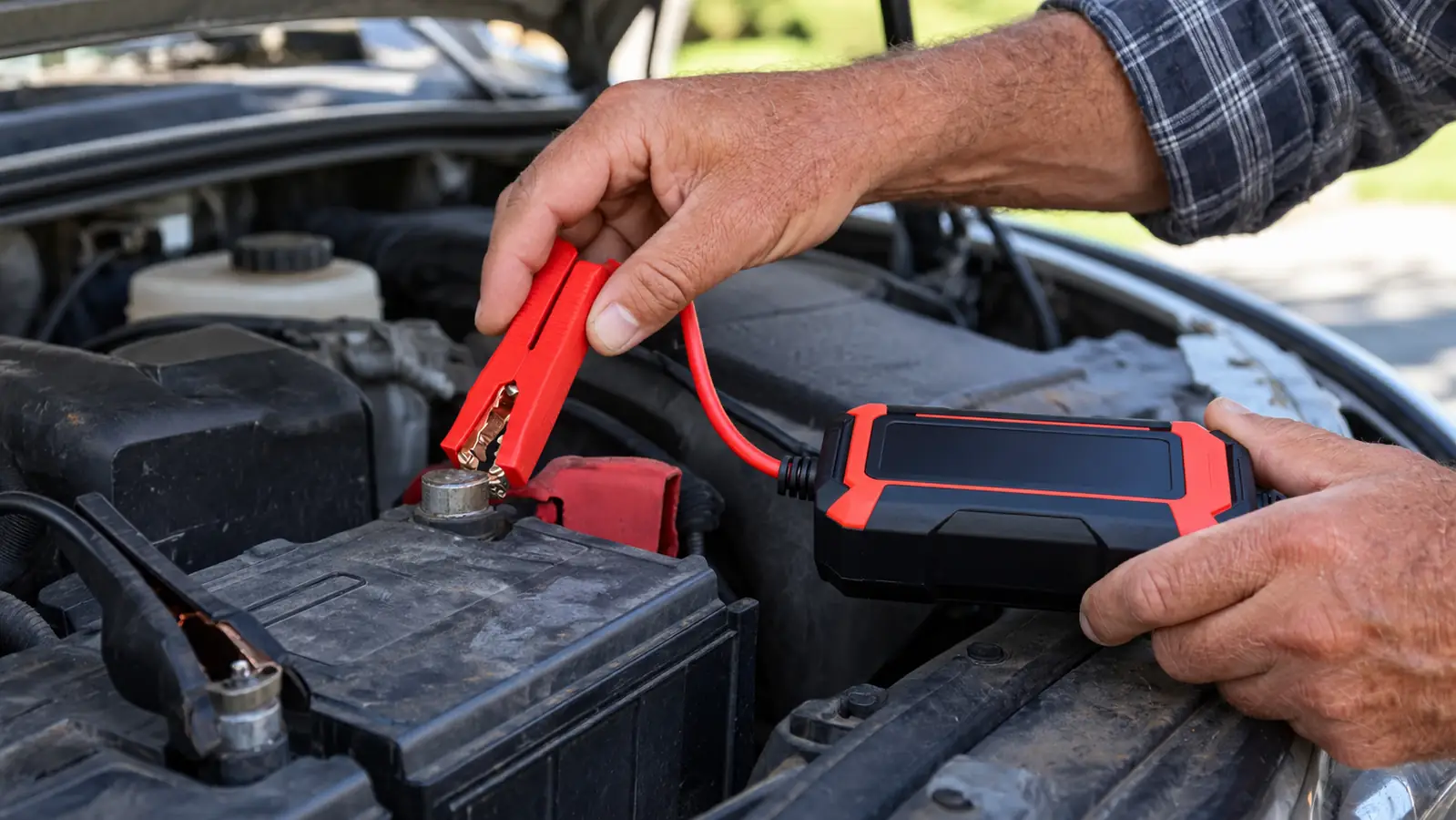
My routine is simple. When the truck is going to sit for more than a couple of days, I pop the hood, connect the ring terminals that came with the unit, and plug it in. The clamps are also in the box, and they work fine, but the ring terminals let me close the hood and walk away. The unit is small enough that it hangs on the fender liner without me rigging anything.
The Genius1 is a 1-amp charger. That is the first thing you need to understand. It is designed to maintain a battery that is already mostly charged, not to charge an empty one. If your battery is at 12.4 volts, the NOCO will bring it up and hold it. If your battery is at 10 volts because you left the dome light on for three days, the Genius1 will eventually get there, but it will take a day or more. I have done it. It works. It is just slow.
The first time I used it for real was the second week of December. The truck had sat for nine days while I was helping my sister move, and the temperature had been in the low 20s for three of those nights. I walked out with a cup of coffee, half expecting the slow crank and the click. Instead the engine turned over like it was June. I checked the battery with my multimeter before I connected anything, and it read 12.6 volts. That was the moment I stopped thinking of the NOCO as a gadget and started thinking of it as part of the routine.
What Nobody Tells You About the NOCO Genius1
The marketing makes the NOCO Genius1 sound like it can do everything. It says 6-volt and 12-volt, it says it can charge lithium batteries, it says it is spark-proof and reverse-polarity protected. All of that is true. What the marketing does not say is that 1 amp is a very small amount of electricity. It is enough to keep a battery healthy. It is not enough to rescue a dead one quickly.
The second thing nobody tells you is that the NOCO Genius1 does its best work when you leave it connected for weeks. This is not a charger you use the night before a road trip. It is a charger you plug in when you park the truck on Sunday and unplug when you drive it on Friday. The people who are disappointed with this unit are usually the ones who expected a 10-amp charger in a 1-amp body.
The third thing is the cable length. The cables are about 3.5 feet long, which is fine for a car or a pickup, but it means the unit has to sit close to the battery. On my F-150, the battery is on the driver side, so the Genius1 hangs right there and the cord reaches the outlet. On a car with the battery in the trunk, you will need an extension cord. That is not a deal breaker, but it is worth knowing before you buy.
The fourth thing is the way the LED blinks. The manual explains it, but you will not remember it, and the first time you see a blinking red light you will assume something is wrong. It is not. The red light just means the unit is in a different stage of the charge cycle. I spent a full evening convinced I had a bad unit, reading the manual by flashlight, before I realized the blinking was normal. If you are the kind of person who does not read manuals, know that a blinking light is not an emergency.
The people who are disappointed with this unit are usually the ones who expected a 10-amp charger in a 1-amp body.
What Works
The NOCO Genius1 has one job, and it does it better than anything I have used. It keeps a battery at the right voltage without cooking it. The unit switches between bulk charge, absorption, and float automatically. I do not have to think about it. I have left it connected for three weeks straight while I was helping my brother-in-law rebuild a deck, and the battery was at 12.8 volts when I came back.
The spark-proof feature is real. I have connected the clamps in the dark, in the rain, and in a hurry, and I have never seen a spark. The reverse-polarity protection is also real. I connected it backwards once, on purpose, to see what would happen. The unit simply refused to start charging. It did not blow a fuse, it did not smoke, it just sat there with the error light on until I fixed it.
The build quality is better than the price suggests. The case is tough plastic, the clamps have good spring tension, and the ring terminals are solid. I have dropped it off the fender onto concrete twice. It still works. The LED lights are bright enough to read in direct sunlight, which matters when you are working in a driveway in July.
The ring terminals are the part I did not expect to like as much as I do. I bolted them onto the battery posts one afternoon in about ten minutes, routed the little wire so the hood would not pinch it, and now connecting the NOCO is a two-second job. I do not even open the hood all the way. I reach in, plug the connector together, and close it. On a truck that sits as much as mine does, that convenience is the difference between using the maintainer and not using it.
What Does Not Work
The biggest weakness is the charging speed. At 1 amp, the NOCO Genius1 is not going to charge a deeply discharged battery in any reasonable time. I helped a neighbor whose sedan had been sitting for six months. The battery was at about 11 volts. The Genius1 brought it back, but it took almost two days. A 4-amp or 10-amp charger would have done it in a few hours. If you regularly deal with dead batteries, buy a bigger charger.
The second weakness is the lack of a display. The Genius1 has LEDs, not a screen. You can tell if it is charging, if it is in float mode, or if there is an error, but you cannot see the actual voltage or amperage. For a weekend mechanic who wants to know exactly what is happening, that is a little frustrating. The NOCO Genius5 has a display, and it costs more. If you are the kind of person who likes data, spend the extra money.
The third weakness is the power cord. It is about 3 feet long, which is fine for most garages, but it is not heavy-duty. I have not had a problem with mine, but I can tell it is not built for abuse. If you plan to drag it around the garage and step on the cord, you might want to be careful.
The fourth weakness is one I only found by accident. The NOCO Genius1 does not have a handle or a hook, so there is no good place to hang it. I have it resting on the fender liner, which works, but it slides around when I close the hood. I solved it with a short piece of bungee cord looped through the mounting hole on the back. It is not a reason to avoid the unit, but it is the kind of thing you will figure out on your own.
What I Liked
- Keeps a healthy battery topped off for weeks without overcharging
- Spark-proof clamps and reverse-polarity protection actually work
- Ring terminals make it a two-second connect once installed
- Small and light enough to hang on a fender liner
- Handles 6-volt, 12-volt, and lithium batteries
Where It Falls Short
- 1 amp is too slow to rescue a deeply discharged battery quickly
- No display, only LEDs, so you cannot see voltage or amperage
- Cables are short, about 3.5 feet, and the power cord is not heavy-duty
- No handle or hook, so it slides around unless you rig something
How It Compares to the Battery Tender Junior
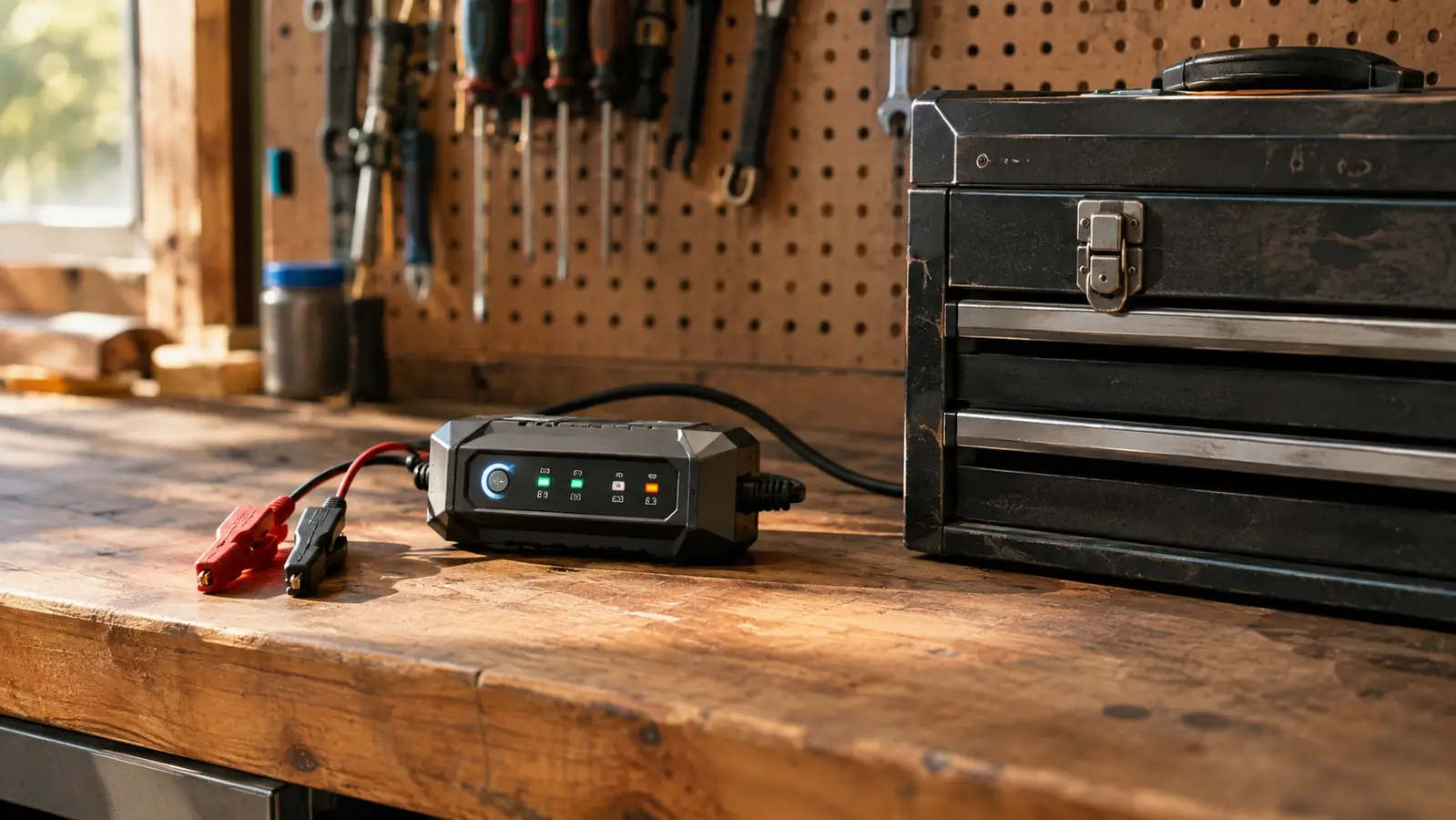
The Battery Tender Junior is the other maintainer everyone asks about. I have used both. The NOCO Genius1 is smaller, lighter, and has reverse-polarity protection, which the Battery Tender Junior does not have. The NOCO also handles 6-volt batteries and lithium batteries, which the Junior does not. The Junior has a slightly longer cord and a slightly lower price. For my money, the NOCO is the better buy, but the Junior is not a bad tool.
The real difference is the charging profile. The NOCO uses a multi-stage process that is gentler on the battery. The Junior uses a simpler process that is also fine, but it is not as smart. If you are maintaining a battery that is already healthy, both will work. If you are maintaining a battery that is marginal, the NOCO is more likely to bring it back.
I will say this for the Junior, though. Its hook is a real hook, and its cord is a little longer, so it is easier to hang in a tight spot. On my neighbor's sedan, where the battery sits under a plastic cover, the Junior was actually easier to set up. The NOCO wins on brains and safety, but the Junior wins on pure convenience. If you are only maintaining one battery and you never connect things backwards, either one will serve you fine.
Who This Is For
The NOCO Genius1 is for the person who has a car, truck, motorcycle, or lawn mower that sits for more than a week at a time. It is for the person who has come out to a dead battery one too many times and wants it to stop happening. It is for the person who wants to set it and forget it, and who does not want to think about overcharging or boiling a battery.
It is also for the person who has a classic car or a seasonal vehicle. I have a neighbor who stores his old pickup in a shed from November to March. He uses the NOCO Genius1 with the ring terminals, and the battery is always ready when he wants to take it out. That is exactly the use case this unit was built for.
It is for the person who owns one vehicle and wants to stop thinking about it. If you are not the kind of person who enjoys fiddling with chargers, the NOCO Genius1 is about as close to set-and-forget as this category gets. You connect it, you walk away, and the battery is still good when you come back. That is the whole job.
Who Should Skip It
Skip the NOCO Genius1 if you need to charge a dead battery fast. If you are the person who leaves the lights on and needs the truck running in 20 minutes, you need a 4-amp or 10-amp charger, or a jump starter. The Genius1 is not that tool.
Skip it if you want to see voltage and amperage on a screen. The LEDs tell you what you need to know, but they do not give you data. If you are the kind of person who wants to watch the numbers climb, get the NOCO Genius5 or a charger with a display.
Skip it if you have a large battery bank or a big diesel truck with two batteries. One amp is not enough to maintain a large battery bank. You would be better off with the NOCO Genius2 or Genius5, which put out more current.
And skip it if you are the kind of person who buys a tool once and expects it to do every job. The NOCO Genius1 is a specialist. It maintains. It does not rescue. If you want one device that charges fast, jumps a dead battery, and maintains it all winter, you are looking at the wrong category entirely, and no 1-amp unit will ever make you happy.
The maintainer I leave on my truck all winter
If your vehicle sits for days at a time, the NOCO Genius1 is the cheapest insurance against a dead battery. It is the one I trust on my own F-150.
Amazon Check Today's Price on Amazon →